
Understanding the card
Its symbolic meaning
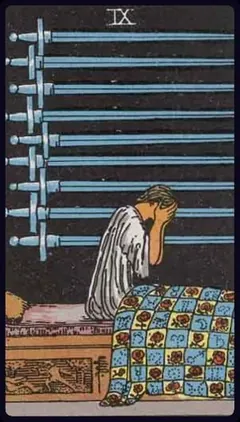
The Nine of Swords represents anxiety and mental anguish. Worry and fear overwhelm, often worse at night. These fears may be exaggerated or self-created; seek support and remember that dawn follows darkness.
What this meditation explores
The waking figure beneath the row of swords shows thought filling a space meant for rest. Meditation explores the repeated story within a worry, distinguishing present experience from an imagined future that keeps returning.
Elements to contemplate
Figure in bed: sleepless worry. Nine swords on wall: overwhelming thoughts. Hands covering face: despair and anguish.
Rider–Waite–Smith symbolism · Waite (1910/1911). Contemporary contemplative approach: Vialunis. Sources below.
Preparation
Sit comfortably with this card visible. Keep your eyes open and breathe naturally. The symbols described come from the Rider–Waite–Smith deck; if your deck differs, use that description as a reference. Spend a quiet interval with each question. You may repeat a step, pause or stop; no answer is required.
Steps
- Feel the support beneath your body. Look at the whole card, then recall a manageable situation related to this intention. You do not need to revisit your hardest experience.
- Notice the waking figure beneath the swords: thought occupies the space of rest.
- Separate a present fact from the feared scene your mind keeps replaying.
- Write one question to check later and let this moment be for resting.
- Return your attention to the room and move gently. Notice what remains with you, even if no answer appeared. You can return to this practice whenever useful.
Closing
Return your attention to the room and move gently. Notice what remains with you, even if no answer appeared. You can return to this practice whenever useful.
For your note
Write one question to check later and let this moment be for resting.
Grounding: Symbolism: Rider–Waite–Smith, Pamela Colman Smith's images and A. E. Waite's commentary (1910/1911). Method: contemporary guided contemplation. Waite suggests individual reflection on the major trumps in Part II §3; applying this five-step format to this card is the app's own adaptation, not a historical ritual.
Sources
- A. E. Waite, The Pictorial Key to the Tarot (1910/1911), III §2: Nine of Swords. Pamela Colman Smith (1909).
- Method: look at the card, reflect quietly, then consider a small personal action. The prompts are original; the cited source supports the symbolism.