On this page
The image and its symbols
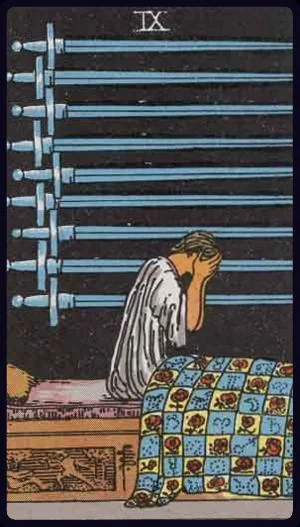
A woman sits upright on her couch in the dead of night, her face buried in her hands, caught in lamentation. Above her, nine swords hang ranged along the dark wall — present, oppressive, yet not one of them touches her. Waite calls her one "who knows no sorrow which is like unto hers," and names the scene "a card of utter desolation." Everything here happens in the inner world: the room is silent, the danger is nowhere in sight, and still she cannot look up. It is the portrait of grief and dread at the hour when no comfort seems possible.
Keys
- Nine swords on the wall
- Accumulated worries hanging overhead — thoughts that oppress without actually striking.
- Face buried in hands
- Sorrow turned inward; the refusal or inability to look at anything else.
- The couch at night
- Sleeplessness and the private hour when troubles feel largest.
- Surrounding darkness
- Isolation that magnifies fear; nothing outside the mind confirms the dread.
- Swords that do not pierce her
- The suffering is mental anguish, anticipation rather than wound.
Upright meaning
- anguish
- sleepless dread
- despair
- disappointment
- deception
- delay
Waite's meanings for this card are among the heaviest in the deck: failure, loss, delay, deception, disappointment, despair. He calls the image one of utter desolation — a sorrow that feels incomparable to the one who carries it. This is the card of the sleepless night, when a setback or a fear expands in the dark until it fills the whole room.
Yet the picture holds a quiet clue. The swords hang on the wall; none of them touches the grieving figure. Much of what torments you right now lives in anticipation, memory, or worst-case imagining. That does not make the pain less real — despair is real — but it does mean the situation and the suffering are not the same size. Something may genuinely have failed, been delayed, or proven false. The anguish layered on top of it is where you still have a hand.
When this card appears, take the sorrow seriously and take the hour into account. Conclusions drawn at three in the morning are rarely trustworthy. Say the fear out loud to someone, write it down, let daylight measure it. Desolation loosens its grip the moment it is witnessed.
Love
A relationship worry is keeping you up at night — regret over something said, fear of loss, or grief after a disappointment or deception. The card asks you to notice how much of this anguish is being suffered alone, in silence. Unspoken dread grows; spoken, it usually shrinks. If a loss is real, let yourself mourn it openly rather than replaying it in the dark.
Work & money
Anxiety about failure, delay, or a decision gone wrong dominates your working mind — possibly out of proportion to the facts. A project may truly have stalled or disappointed, but catastrophising about it costs you the clarity needed to respond. Separate what has actually happened from what you fear will happen, put the worry on paper, and deal with the solvable piece first.
Spirituality
This is the dark night in its rawest form: the hour when meaning seems to have drained away and no comfort answers. The tradition does not ask you to bypass this despair but to sit through it honestly — it is part of the path, not a failure of it. Grief that is fully felt eventually moves. Even here, the swords hang above you; they are not in you.
Reversed meaning
- suspicion
- doubt
- reasonable fear
- shame
- confinement
Waite's reversed meanings are imprisonment, suspicion, doubt, reasonable fear, and shame — and his supplementary note adds that there may be good ground for suspicion against a doubtful person. Reversed, the anguish takes on a more confined and specific shape. You may feel trapped by a situation, or held hostage by a fear that, this time, is not imaginary: something or someone genuinely warrants caution. Doubt gnaws, and shame keeps the whole thing hidden, which tightens the trap. The counsel is discrimination. Examine the fear in the light: if it is reasonable, act on it — verify, protect yourself, seek help. If it is shame doing the talking, remember that secrecy is its oxygen. Naming what confines you is the first bar removed.
Love
A suspicion or doubt about someone may deserve honest examination rather than dismissal — Waite allows that some fears are reasonable. Check quietly before accusing, and do not let shame about your own feelings keep you silent and stuck. If trust has genuinely been broken, facing it frees you faster than doubting yourself in the dark.
Work & money
You may feel imprisoned in a role, or rightly wary of a colleague or arrangement that does not add up. Take the doubt seriously enough to investigate: review the facts, the contract, the numbers. Hiding a mistake out of shame only extends the sentence; disclosure, however uncomfortable, opens the door.
Spirituality
Reversed, the card points to self-imprisonment — shame and doubt walling you off from renewal. Reasonable fear is a teacher; corrosive shame is not. Practice telling them apart. Confess the hidden thing to yourself, a trusted person, or the page of a journal, and notice how the cell was never actually locked.
Yes or no?
No
Waite reads it as a card of utter desolation — failure, disappointment, despair — a traditionally negative omen.
Advice of the day
If this is your card today, treat your mind gently and skeptically at once. Do not make big decisions in the anxious hour; wait for daylight, literally or figuratively. Write the worry down, tell one trusted person, and check each fear against what has actually happened. Care for the basics — rest, food, breath — because anguish feeds on depletion. The swords are above you, not in you; you can still stand up.
Reflections
- Which of my current fears has actually happened, and which am I only rehearsing?
- Who could I tell about this worry, and what keeps me from saying it aloud?
- When did I last let daylight — facts, perspective, rest — measure this problem?
I face my fears in the light, and I do not confuse the night's voice with the truth.