On this page
The image and its symbols
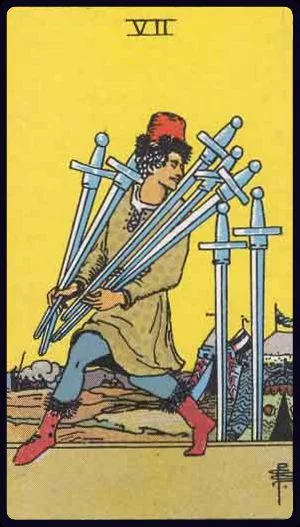
A man hurries away from a military camp, carrying five swords bundled awkwardly in his arms; two more remain stuck upright in the ground behind him. Waite describes him simply as 'in the act of carrying away five swords rapidly,' with 'a camp close at hand.' The figure moves on tiptoe, glancing back over his shoulder toward the bright tents he is leaving. The scene is quick, furtive and unfinished: whatever he set out to take, he could not take it all, and the camp he robs is near enough to notice him at any moment.
Keys
- Five swords carried away
- A bold attempt that succeeds only in part; the plan captures most, not all.
- Two swords left in the ground
- What the scheme leaves behind — loose ends that can undo the whole design.
- The camp close at hand
- The risk of discovery; acting alone under the eyes of a group.
- The backward glance and tiptoeing step
- Stealth mixed with nerves; confidence shadowed by the fear of being caught.
Upright meaning
- stealth
- strategy
- risky scheme
- acting alone
- evasion
- partial success
Waite's meanings for this card pull in two directions at once, and he says so plainly: design, attempt, wish, hope and confidence on one side; quarrelling, annoyance and 'a plan that may fail' on the other. The Seven of Swords is the card of the lone operator — someone acting on their own initiative, relying on wits rather than strength, trying to get away with something before anyone notices.
Sometimes that is exactly what a situation calls for. Not every problem can be met head-on, and there is real intelligence in choosing an indirect route, keeping your intentions quiet, or withdrawing from a fight you cannot win. The confidence Waite names is genuine: this figure believes in his plan.
But the image tells you the catch. He carries five swords and leaves two behind. Schemes hatched in secret tend to be incomplete, and what gets left in the ground has a way of coming back. Ask yourself honestly whether the cleverness here is serving you — or whether you are simply avoiding a conversation, a confrontation or a piece of work that will be waiting for you either way.
Love
Something in this relationship is being handled indirectly — a feeling unspoken, a plan kept private, perhaps a small deception that felt harmless at first. If you are single, someone's charm may be running ahead of their honesty, including your own. The card does not accuse; it observes. Strategy has its place in love, but intimacy cannot be won by stealth. Whatever you are carrying quietly out of the camp, decide whether you would rather be caught with it or set it down yourself.
Work & money
A workaround, a shortcut, or a solo move made without full disclosure — this is the atmosphere at work and with money. It may even be smart: acting quickly, keeping a plan close to your chest, avoiding an unwinnable office battle. But Waite warns the design is uncertain and may fail. Check the two swords you are leaving behind: the detail unfinished, the colleague not told, the corner cut. Partial success now can cost you trust later. Get away cleanly or don't go.
Spirituality
Spiritually, this card asks where you are being evasive with yourself. It is possible to tiptoe around your own inner work — collecting insights like stolen swords while avoiding the one truth that actually matters. The mind is inventive, and cleverness can become a way of never being fully present. Practice honesty in small, private ways: name what you are avoiding. What is taken by stealth from the inner life never quite belongs to you; what is faced directly does.
Reversed meaning
- good counsel
- coming clean
- second thoughts
- loose talk
- getting caught
Reversed, Waite gives this card a striking turn: good advice, counsel, instruction — alongside slander and babbling. The secret is coming out, one way or another. At best, this is the moment of coming clean: returning what was taken, admitting the shortcut, or accepting guidance you would have refused before. Someone wiser may be offering exactly the counsel you need — Waite's older sources add that such advice is 'probably neglected,' so make a point of not neglecting it. At worst, the talk turns careless: gossip, indiscretion, words spilled that should have been weighed. Either way, the era of quiet maneuvering is over. Choose confession over exposure while the choice is still yours.
Love
The hidden thing surfaces — a secret told, a suspicion confirmed, or an honest conversation finally had. If you have been less than open, come forward before you are found out; it changes everything about how the truth lands. Beware gossip about a partner: listen to counsel, not chatter.
Work & money
A workplace secret leaks, a shortcut is discovered, or you decide to disclose it first. Good advice is available now — a mentor, a colleague, a plain-spoken warning. Take it seriously rather than defending the old plan. Watch loose talk around money and colleagues; discretion protects you.
Spirituality
A period of self-honesty opens. What you were avoiding becomes visible, and with it, relief. Seek instruction — a teacher, a book, a trusted friend's counsel — instead of improvising alone. Confession, in whatever form suits you, is the practice: naming the avoidance dissolves most of its power.
Yes or no?
It depends
Waite calls its significations 'widely at variance' — a plan that may succeed or fail, so the answer hangs on honesty and execution.
Advice of the day
Today, notice where you are maneuvering instead of speaking. If a quiet, strategic approach is genuinely wise, commit to it fully and tie up the loose ends — half-executed schemes are the ones that fail. But if you are avoiding a person or a truth, go back for the two swords: face the thing directly. And if good advice arrives today, treat it as the gift it is rather than a threat to your plan.
Reflections
- What am I currently handling by stealth that would be simpler to handle by honesty?
- Which two swords am I leaving behind — what loose ends could undo my plan?
- Whose advice am I neglecting because it threatens a scheme I'm attached to?
I use my cleverness in service of the truth, not instead of it.