On this page
The image and its symbols
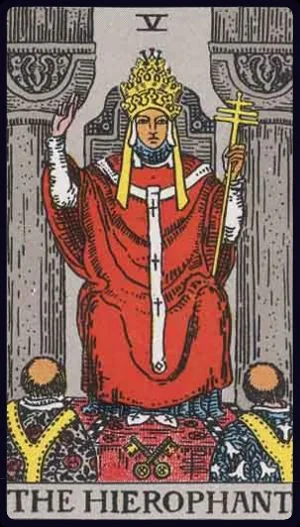
A pontifical figure wears the triple crown and sits enthroned between two pillars, though Waite is careful to say they are not the pillars of the High Priestess's temple. His left hand holds a scepter ending in a triple cross; his right is raised in the ecclesiastical sign of esotericism, which distinguishes, in Waite's words, "between the manifest and concealed part of doctrine." At his feet lie the crossed keys, and two priestly ministers in albs kneel before him. He is the ruling power of external religion, Waite writes, the channel of grace belonging to the world of institution, and the head of the recognized hierarchy.
Keys
- Triple crown
- Authority reaching through three worlds; teaching that spans body, mind and spirit.
- Triple-cross scepter
- Sacred office made visible; doctrine carried as a formal instrument of blessing.
- Raised hand of esotericism
- Some truth is spoken openly, some reserved; teaching meets the student where they are.
- Crossed keys
- The power of the keys: access to grace through recognized, institutional channels.
- Two kneeling ministers
- Knowledge transmitted through lineage; learning that passes from teacher to devoted student.
- Two pillars
- The gateway of established doctrine, distinct from the High Priestess's hidden temple.
Upright meaning
- tradition
- spiritual guidance
- alliance
- mentorship
- institutions
- shared belief
Waite's meanings for this card begin with marriage and alliance: bonds made formal, blessed and witnessed. The Hierophant appears when a connection, a commitment or a course of study is ready to be sealed inside a shared framework rather than kept private and provisional. He is also, in Waite's phrase, "the man to whom the Querent has recourse": the mentor, teacher, counselor or trusted institution you turn to when your own map runs out. By another account the card carries mercy, goodness and inspiration, and that is the warmer face of tradition: the accumulated kindness of everything that worked before you arrived.
Waite is honest about the shadow inside the gift. Alongside alliance he lists captivity and servitude, because the same structures that hold you can also hold you in. The channel of grace belongs to the world of institution, and institutions ask for conformity as their price.
Read upright, the balance tips toward trust. Follow the proven path for now. Seek the teacher, honor the ceremony, learn the rules deeply. You can only transcend a tradition you have genuinely understood.
Love
This is one of the classic cards of marriage and formal alliance. A relationship may be moving toward commitment that others witness and recognize: an engagement, a ceremony, meeting the families, naming what you are to each other. It favors shared values as the real glue of partnership, and love built on goodness and mercy rather than novelty. If questions arise, guidance from a counselor or a trusted elder helps. If single, someone may arrive through community, study or faith.
Work & money
Professionally the Hierophant points to established structures: institutions, certifications, apprenticeships, companies with clear hierarchies and time-tested methods. Progress now comes from working within the system, learning from a senior figure, and honoring the conventions of your field before challenging them. Alliances and formal agreements are favored; get things properly signed and sanctioned. Financially it counsels the traditional route: reputable advisors, proven vehicles, patience. Waite's note of servitude is the caution: belong to the institution without being owned by it.
Spirituality
Waite names him the ruling power of external religion, the outer side of the life that leads to the doctrine. This is spirituality practiced in community: ceremony, lineage, teachers, texts, the inherited forms that carry inspiration to "the human race at large." The card invites you to receive from a tradition rather than improvising alone, while remembering Waite's warning that the officiant can forget he only symbolizes what is greater than himself. Honor the form; keep sight of what it points to.
Reversed meaning
- over-kindness
- weakness
- loose consensus
- diluted doctrine
- social conformity
Waite's reversed meanings are gentle and slightly ironic: society, good understanding, concord, over-kindness, weakness. The formal structure loosens. Agreement is reached not through doctrine or ceremony but through easy sociability, and rules give way to accommodation. Sometimes that is exactly the medicine: rigid orthodoxy relaxing into genuine human concord, hierarchy dissolving into fellowship among equals. But Waite's last two words carry the warning. Over-kindness means saying yes to keep the peace; weakness means no one will hold a standard when holding it would cost something. Reversed, the Hierophant asks where your agreeableness has replaced your convictions. Consensus that no one truly believes in is not harmony, only politeness. Find the one principle you are not willing to soften, and stand on it kindly.
Love
Harmony reigns, perhaps too easily. A relationship may run on pleasant accord while avoiding the conversations that would make it real. Over-kindness, agreeing to everything, keeps the peace but erodes respect. Formal commitment may be deferred in favor of comfortable informality. Be warm, but be honest about what you actually want.
Work & money
The workplace favors sociability over structure now: decisions by friendly consensus, standards bent to keep everyone comfortable. That eases tension but breeds weakness, and unowned agreements quietly unravel. Beware advice given to please rather than to help. Keep the good understanding; put the essentials back in writing.
Spirituality
Practice may have drifted into pleasant community without depth, belonging without belief. Or a rigid framework is rightly loosening its hold on you. Either way, over-accommodation is the risk: a path that never challenges you cannot change you. Ask what you actually hold sacred, apart from what the group approves.
Yes or no?
Yes
Traditionally favorable for unions, alliances and guidance; yes, especially by the established, sanctioned path.
Advice of the day
Today, let yourself be taught. Ask the person who has walked this road before you, consult the established source, follow the proven procedure instead of improvising. If a commitment is waiting to be formalized, take the formal step. Honor a tradition that has held you, even in a small ritual way. Received wisdom is not a cage today; it is a shortcut through terrain others have already mapped.
Reflections
- Whose guidance do I trust, and have I actually asked for it?
- Which of my beliefs are truly mine, and which did I inherit without examining?
- Where would a formal commitment give my life more freedom, not less?
I honor the wisdom handed down to me, and I make it truly my own.