On this page
The image and its symbols
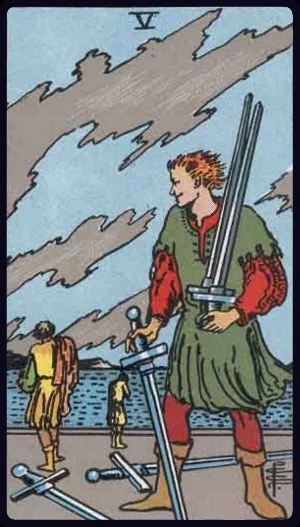
A disdainful man stands in the foreground, watching two retreating, dejected figures walk away from him. Their swords lie abandoned on the ground where they dropped them. The victor carries two blades slung over his left shoulder, while a third rests in his right hand, its point turned to the earth. As Waite puts it, "he is the master in possession of the field" — yet the field he has won is emptying. The scene captures the moment just after a fight ends: one man holds all the weapons, and everyone, including him, has lost something.
Keys
- The disdainful victor
- Winning without grace; contempt for the defeated poisons the triumph itself.
- Two retreating figures
- Those who withdraw from conflict, carrying dejection but also their dignity away.
- Swords abandoned on the ground
- What people surrender rather than keep fighting for; the debris of a quarrel.
- Three swords gathered by the winner
- Spoils claimed at others' expense — possession without honour.
- The empty field
- Mastery of a place no one else wants to share; isolation as the prize.
Upright meaning
- conflict
- hollow victory
- defeat
- dishonour
- self-interest
- loss
Waite's meanings for this card are stark: degradation, destruction, revocation, infamy, dishonour, loss — and their many variants. This is the aftermath of a battle in which the terms of victory were set so low that no one truly won. Someone claimed the field, but the cost was trust, reputation, or self-respect.
When this card appears, look honestly at a conflict in your life. You may be the figure collecting swords, the one walking away, or both at different moments. If you are winning, ask what kind of victory it is — one that others will remember with resentment rarely holds. If you are losing, notice that the retreating figures in the image keep something the victor lacks: the freedom to leave the field behind.
The deeper counsel is about limits. Some battles degrade everyone who fights them. Revocation — the undoing of something once granted — reminds you that gains taken this way can be taken back. Ask whether the argument, the point, or the prize is worth what it demands of you, and be willing to name a loss as a loss so you can stop paying for it.
Love
A quarrel has left a bruise, or is about to. In relationships this card often shows an argument won at the expense of closeness — the sharp remark that lands, and the silence that follows. If you have been keeping score, notice that scorekeeping is a way of losing together. Repair begins when someone puts a sword down first; pride is the only thing standing on that field.
Work & money
Watch for a workplace battle where the win damages the winner: a credit dispute, a rivalry, a point proved at a colleague's expense. Waite's supplementary note warns of an attack on the querent's fortune, so guard your resources and reputation, read agreements carefully, and avoid contests where even success would cost allies. Sometimes the strongest professional move is a strategic, dignified withdrawal.
Spirituality
This card asks what your ego is willing to destroy in order to feel right. Infamy and dishonour are inner states before they are public ones: the private knowledge that you fought unfairly. Spiritually, the invitation is disarmament — letting go of the need to master the field. Loss, accepted consciously, can become the beginning of humility rather than the end of worth.
Reversed meaning
- lingering resentment
- mourning
- endings acknowledged
- release
- aftermath
Waite gives the reversal the same core meanings — the loss and dishonour remain — and adds "burial and obsequies." Reversed, the battle is over but not yet laid to rest. Something has ended, and what is asked of you now is the equivalent of a funeral: honest acknowledgement, grief, and closure. The supplementary meanings speak of sorrow and mourning, which is not a punishment but a process. Resentment kept alive is a sword you go on carrying. Reversed, the Five of Swords counsels you to name what died in the conflict — a friendship, a plan, an image of yourself — mourn it properly, and leave the field so the ground can recover.
Love
An old fight still shapes the present. Reversed, this card points to grief after a rupture — mourning what the relationship was before the quarrel. Healing asks for an honest burial of grievances: apology where it is owed, forgiveness where it is possible, and no more exhuming old wounds as ammunition.
Work & money
A professional defeat or dispute needs formal closure. Settle what remains, document endings cleanly, and resist reopening a fight that is already lost or already won. Waite's darker notes counsel accepting the outcome; energy spent on resentment is energy stolen from your next endeavour.
Spirituality
Mourning is spiritual work. Reversed, this card invites a conscious rite of release — acknowledging loss instead of numbing it. What you bury with respect stops haunting you. Let sorrow move through, and notice how the ground of you feels lighter once the swords are finally laid down.
Yes or no?
No
Waite's meanings — degradation, dishonour, loss — mark this as a traditionally negative card.
Advice of the day
Today, refuse the hollow win. If a conflict is brewing, ask whether victory would cost you respect, trust, or peace — and if it would, step off the field on your own terms. Where a loss has already happened, name it plainly and let it be over. Put down any sword you are carrying purely out of pride; you will move faster without it.
Reflections
- Where in my life am I winning in a way that costs me more than losing would?
- What conflict am I still carrying that deserves a proper burial?
- If I walked away from this fight today, what would I actually lose — and what would I keep?
I choose my battles with honour, and I release the ones that diminish me.