On this page
The image and its symbols
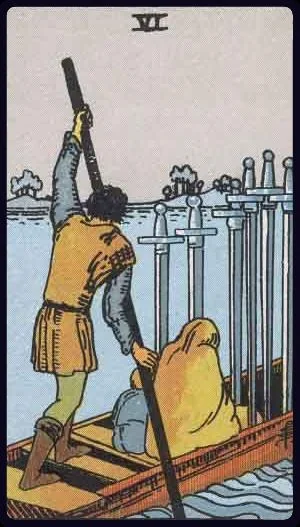
A ferryman poles his punt across the water, carrying passengers toward the further shore. A cloaked figure sits with head bowed beside a child, and six swords stand upright in the bow of the boat, travelling with them. Waite notes that "the course is smooth," and that since the freight is light, "the work is not beyond his strength." Nothing dramatic happens in this image — and that is its message. It is a picture of steady, manageable passage: burdens carried rather than abandoned, difficulty left behind at a bearable pace, with someone capable at the oar.
Keys
- The ferryman
- Steady, competent help; the strength needed for this crossing is sufficient.
- The passengers
- Those in transit — grief travels with them, but so does forward motion.
- The six swords in the boat
- Thoughts and troubles carried along, upright and contained, not discarded.
- The smooth course
- Waite stresses the passage is calm; the worst turbulence lies behind.
- The further shore
- A destination not yet reached but clearly in view — hope with a bearing.
Upright meaning
- transition
- passage
- leaving behind
- guidance
- gradual relief
- travel
Waite's meanings gather around movement: journey by water, route, way, envoy, expedient. This is the card of passage — not the storm and not the arrival, but the crossing in between. Something in your life is being ferried from a harder place to an easier one, and the essential news is Waite's own observation about the scene: the course is smooth, and the work is not beyond the ferryman's strength. You can make this crossing.
Transitions of this kind are rarely triumphant. The passengers in the boat sit low and quiet, because leaving even a painful situation involves grief. Yet the swords travel upright in the bow: you do not have to pretend the difficulties never happened, only to carry them in an ordered way while you move. An expedient — a practical, workable solution rather than a perfect one — is often exactly what this card endorses.
Sometimes the journey is literal: travel, relocation, a change of surroundings that changes the mind. More often it is inward, a shift from turbulent thinking toward calmer water. Either way, trust the route you are on, accept help from whoever is holding the pole, and keep facing the further shore.
Love
A relationship is moving out of choppy water — or you are moving on from one. If you are together, this card favours a deliberate change of atmosphere: less rehashing of old arguments, more quiet forward motion, perhaps literally a trip taken together. If you are leaving, the departure is right even though it aches. Healing here is gradual and travels at the speed of the boat, not the speed of wanting.
Work & money
Waite's words — route, envoy, commissionary — suit work in motion: a transfer, a new role, business travel, or acting as the go-between who carries a message across a divide. A practical, workable fix will serve better than holding out for the ideal. Financially, favour steady passage over risky leaps; move resources out of troubled ground calmly and methodically, and let progress compound quietly.
Spirituality
The crossing is an old image of the soul in transition, and this card honours the unglamorous middle of change. Spiritually you are between shores: the former certainties no longer hold, the new ground is not yet underfoot. Practice being ferried — trusting a rhythm larger than your own effort. Peace here is not the absence of swords but their quiet, ordered company.
Reversed meaning
- declaration
- confession
- going public
- stalled departure
- unresolved business
Waite reverses this card into speech: declaration, confession, publicity — and, by one account, a proposal of love. What was being carried quietly now asks to be said out loud. Reversed, the Six of Swords often marks the moment a private transition becomes public: an announcement, an admission, a truth that can no longer travel in silence. This can be a relief — confession lightens the freight — but it also means the crossing is interrupted until the words are spoken. The supplementary meanings warn of an unfavourable outcome in a dispute, so choose honesty before you are forced into it. Say the true thing, settle what is open, and the boat can move again.
Love
Something wants declaring. Waite explicitly notes one reading as a proposal of love — reversed, this card can mark the moment feelings go public: a confession, a commitment, an overdue conversation. If a departure has stalled, the delay usually hides an unspoken truth. Speak it kindly and the water clears.
Work & money
A transition at work is delayed or has become visible: news announced, plans disclosed, a dispute airing openly. Waite's note about an unfavourable lawsuit counsels settling conflicts rather than escalating them. Be transparent early, put agreements in writing, and do not launch a move before its foundations are stated plainly.
Spirituality
Confession is the reversed card's medicine: naming aloud what you have carried in silence. Whether to a friend, a journal, or the open sky, articulating the truth converts stalled weight into movement. What you declare, you no longer have to drag — the crossing resumes the moment you are honest.
Yes or no?
Yes
A gently favourable card — Waite calls the voyage pleasant, and its motion is toward calmer water.
Advice of the day
Today, choose passage over paralysis. Take one concrete step away from a situation that has been churning — book the trip, send the message, move the task, change the room you think in. Accept help if someone offers to hold the pole for a while. You do not need to solve everything before leaving; carry your unfinished business upright in the boat and keep moving toward quieter water.
Reflections
- What troubled water am I ready to leave behind, even if the leaving is quiet and unglamorous?
- Which of my burdens can travel with me in good order, and which belong on the old shore?
- Who is my ferryman right now — and am I letting them help?
I am crossing to calmer water, and the strength this passage needs is already mine.