On this page
The image and its symbols
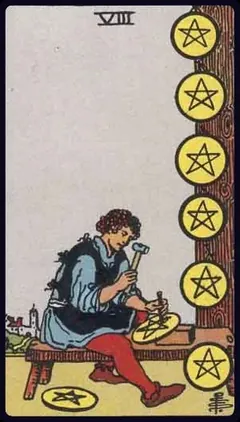
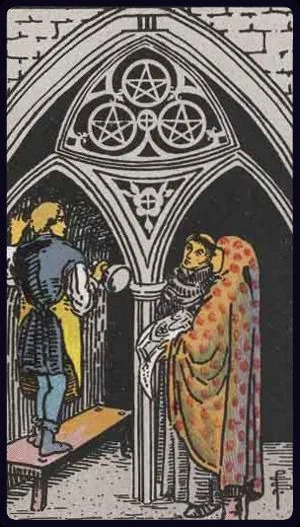
Waite shows 'a sculptor at his work in a monastery.' The craftsman stands raised on a bench inside a sacred building, tools in hand, carving the stone of an archway in which three pentacles are set. Beside him, a monk and a hooded figure holding the plans of the building look on and confer with him: the design belongs to all three. Waite asks us to compare this scene with the Eight of Pentacles — 'the apprentice or amateur therein has received his reward and is now at work in earnest.' Practice has become profession; the worker is trusted, consulted, and building something meant to outlast him.
Keys
- Sculptor on his bench
- Skill that has earned standing; the craftsman is literally elevated by his work.
- Monastery setting
- Work in service of something larger and more enduring than the worker.
- Monk and figure with the plans
- Collaboration between vision, patronage, and hands-on skill; each role needs the others.
- Three pentacles in the archway
- Craft made permanent — value built into the very structure.
- Working tools in hand
- Mastery in action, not theory; the reward of the earlier apprenticeship.
Upright meaning
- craftsmanship
- collaboration
- skilled work
- recognition
- building to last
- earned trust
Waite names this card plainly: métier — trade, skilled labor. It is the card of the professional, the person whose craft has passed beyond practice into genuine competence. He deepens it further, noting it is 'usually regarded as a card of nobility, aristocracy, renown, glory.' Good work, done in earnest, ennobles the worker: skill becomes reputation, and reputation opens doors.
The scene itself carries the second message. The sculptor does not work alone; a monk and the holder of the plans stand with him, and the building rises out of their combined roles. When this card appears, your abilities are ready to be used and, just as importantly, ready to be seen. Others are watching your work with approval — a commission, an invitation, a project where your contribution matters is near or already underway.
Waite's contrast with the Eight of Pentacles is the heart of it: the apprentice 'has received his reward and is now at work in earnest.' Whatever you trained for, the training has paid off. Bring your full care to the task at hand, cooperate openly with those who hold the plans, and let the quality of the work speak. Recognition, in this card, is not sought — it is earned.
Love
A relationship built like the mason builds: patiently, with care for the details, and with each partner contributing a distinct skill to the shared structure. This card favors couples who work as a team — planning a home, a project, a future — and singles who meet someone through work, study, or a shared craft. Show your appreciation for what your partner does well; being genuinely valued for one's contribution is one of love's quietest and strongest foundations.
Work & money
One of the best cards for career questions. Your skill is recognized: expect praise from those above you, a meaningful commission, or a role where your expertise is finally consulted rather than overlooked. Waite links it to renown, so reputation grows now — deliver quality and it compounds. Financially it rewards honest labor over speculation; income rises with competence. Collaborate willingly, since the architect, the patron, and the craftsman all profit when the plans are shared.
Spirituality
The sculptor carves inside a monastery: labor and devotion in one gesture. This card teaches that careful work is itself a spiritual practice — attention, patience, and excellence offered to something greater than yourself. You need not choose between the workbench and the altar. Whatever you are building, build it as if it were sacred architecture, and let the discipline of craft become your form of prayer.
Reversed meaning
- mediocrity
- pettiness
- sloppy work
- poor cooperation
- lack of commitment
Reversed, Waite is blunt: 'mediocrity, in work and otherwise, puerility, pettiness, weakness.' The earnest craftsman disappears, and what remains is work done half-heartedly — corners cut, standards lowered, effort withheld. Sometimes the fault is in the labor itself: a job beneath your ability, or ability that has stopped growing because commitment has lapsed. Just as often the fault is in the collaboration: pettiness among colleagues, childish squabbles over credit, weakness in following the shared plan. The monk, the architect, and the sculptor no longer confer, and the building suffers for it. Waite adds that reversed, the outcome 'depends on neighboring cards' — the situation is not doomed, but it will take renewed seriousness to lift it. Ask honestly: where have I settled for adequate when I am capable of excellent?
Love
The shared building has stalled: one partner doing the careful work while the other coasts, or both trading small criticisms instead of real cooperation. Pettiness erodes what patience built. Recommit to the relationship as a craft — deliberate effort, honest consultation, pride in what you make together.
Work & money
Mediocre output, low morale, or a team pulling in different directions. Perhaps your skill is unrecognized — or perhaps commitment has quietly lapsed. Avoid squabbles over credit; they shrink everyone involved. Raise your own standard first, then address the collaboration.
Spirituality
Weakness here is spiritual laziness: going through the motions of practice without earnestness. Puerility is wanting the reward without the apprenticeship. Return to your discipline humbly, as a student again. Depth is rebuilt the same way stone is carved — one attentive stroke at a time.
Yes or no?
Yes
A card of skilled work, renown, and glory in Waite — a favorable sign, especially where effort and merit are involved.
Advice of the day
Treat today's task, however small, as a commission worth your best craft. Do one piece of work with complete care instead of three pieces carelessly, and let someone competent see it. If others are involved, consult the plans together rather than working in isolation — invite feedback and give credit freely. Recognition is moving toward you; meet it with workmanship that deserves it.
Reflections
- Where has my long practice quietly turned into real mastery — and do I own it?
- Who holds the plans in my current project, and am I truly conferring with them?
- In what part of my life have I accepted mediocrity that earnest effort could transform?
I bring my full skill to the work before me, and my craft speaks for itself.