On this page
The image and its symbols
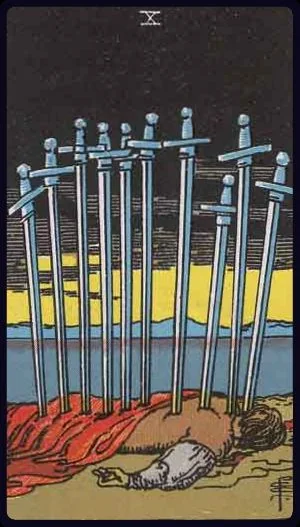
A figure lies prostrate on the ground, pierced by all ten swords belonging to the card — not one blade spared, every sword of the suit driven home. Waite's description is deliberately brief, and he adds a crucial caution: "it is not especially a card of violent death." The scene reads as emblem rather than event. Where one sword would have ended the matter, ten make the point unmistakable: this is over, completely and without appeal. The stillness of the body carries the card's paradoxical mercy — the struggle, the dread, and the fight are finished, and nothing further can be taken.
Keys
- Ten swords in one body
- Excess beyond necessity; the mind's way of declaring an ending absolute.
- The prostrate figure
- Total surrender — no defense left to mount, no struggle left to fight.
- Every sword of the suit present
- The element exhausted; nothing of this cycle remains to arrive.
- The motionless scene
- Finality as stillness; the crisis has fully passed through.
Upright meaning
- rock bottom
- affliction
- finality
- desolation
- defeat accepted
Waite lets the picture speak first — "whatsoever is intimated by the design" — and then names it plainly: pain, affliction, tears, sadness, desolation. Something in your life has reached its full stop. Not a setback that might yet be argued with, but an ending that has already happened: a plan, a relationship, a version of events you were still hoping to save.
Waite is careful to add that this is not especially a card of violent death, and the distinction matters. The Ten of Swords is dramatic in image and symbolic in meaning. The ending it marks is usually the death of a situation or a story, not of a person — and its very excess is instructive. Ten swords where one would do suggests how the mind treats a defeat: as total, monumental, beyond repair.
And yet, because the suit is spent, this card carries a hidden floor. When you have genuinely reached bottom, the dreadful waiting is over. Nothing more of this kind is coming. Grieve honestly — the tears Waite names are legitimate — but notice that acceptance, not resistance, is what this moment asks. Endings this complete are also, quietly, the ground the next thing is built on.
Love
A relationship, or a chapter within one, has ended or must be allowed to end. Waite's supplementary notes even warn of treachery from supposed friends, so the wound may involve betrayal as well as loss. Stop performing rescue on something already finished. Mourn it fully — tears here are honest work — and trust that a heart emptied of false hope has room again for real connection.
Work & money
A project, job, or venture has run its full course and failed, or is about to conclude in a way you cannot reverse. Fighting the verdict wastes what strength remains. Close the accounts cleanly, document the lessons, and resist the urge to relaunch the same battle. Professionally, this is the moment to accept the loss in writing and turn your face toward what comes after it.
Spirituality
The tradition reads this as ego-death: the collapse of a self-image or a story you organized your life around. Its completeness is the gift — half-endings keep you haunted, but total ones set you free. Lie still in the loss for as long as it truly takes. What rises afterward will not be the old self patched up, but something that no longer needs those swords.
Reversed meaning
- temporary advantage
- fleeting success
- borrowed power
- impermanent favor
- regrouping
Waite's reversal turns the card unexpectedly bright, but with a warning stitched in: advantage, profit, success, and favor — "but none of these are permanent" — along with power and authority. His supplementary note even promises victory and consequent fortune for a soldier in war. Reversed, you get a rise after the fall: a recovery, a win, an opening, a position of influence. Take it, and use it well — but do not mistake it for a plateau. What this card grants is provisional by nature. Treat the gain as working capital rather than an inheritance: consolidate quickly, share credit, and build something durable underneath the good moment while it lasts. Power held lightly outlives power gripped.
Love
A reconciliation, a new spark, or relief after a painful stretch arrives — genuinely good, but not yet guaranteed. Enjoy it without loading it with permanence it has not earned. Keep doing the daily work of honesty and attention; a favorable turn becomes a lasting bond only through what you build on top of it.
Work & money
A win, promotion, or profitable turn is available now — Waite explicitly grants success and authority here. Seize the moment and act decisively, but bank the gains: fleeting favor rewards those who convert it into skills, savings, and alliances before the tide moves again.
Spirituality
Recovery after collapse can tempt you to declare the lesson finished. Reversed, this card counsels gratitude without grasping: the renewed energy and standing you feel are real, and also passing, like every state. Practice holding good fortune with open hands, and let impermanence deepen rather than diminish your peace.
Yes or no?
No
Pain, affliction, and desolation make this a traditionally negative card — the matter ends rather than proceeds.
Advice of the day
If this card greets you today, stop bargaining with an ending. Whatever has finished — a plan, a hope, a fight — let it be finished, and give yourself permission to feel the full weight of that. Then do one small act of closure: send the final message, file the last document, say the goodbye. Rock bottom is solid ground; today's task is not to rebuild yet, only to stop falling.
Reflections
- What am I still trying to revive that has, in truth, already ended?
- If I accepted this defeat completely today, what energy would that free?
- What is the one act of closure I have been avoiding?
I let what is over be over, and I rest on the solid ground of what remains.