On this page
The image and its symbols
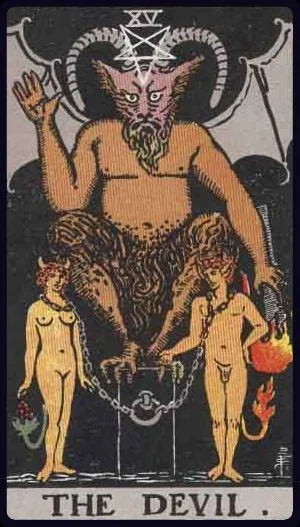
The Horned Goat of Mendes, with wings like a bat's, stands upon an altar. A reversed pentagram marks the forehead and the sign of Mercury sits at the pit of the stomach. The right hand is raised in what Waite calls the reverse of the Hierophant's benediction; the left holds a great flaming torch inverted toward the earth. From a ring on the altar, two chains run to the necks of a male and a female figure, analogous, Waite says, to Adam and Eve after the Fall. Their tails signify the animal nature, yet there is human intelligence in their faces, and their master, himself a bondsman, will not rule them forever.
Keys
- Horned, bat-winged figure
- The brute force of material life enthroned; power without light or love.
- Inverted torch
- Fire turned downward; vital energy burned toward the earth instead of raised.
- Reversed pentagram
- Spirit set beneath matter; the right order of things turned upside down.
- Reversed benediction
- A mocking mirror of the Hierophant's blessing; false authority parodying the sacred.
- Chained man and woman
- Adam and Eve after the Fall; the chain and fatality of the material life.
- Human faces, animal tails
- Intelligence still alive within appetite; the captives are not beasts and not doomed.
Upright meaning
- raw force
- compulsion
- attachment
- extraordinary effort
- what feels fated
- the material grip
Waite's divinatory meanings are blunt: ravage, violence, vehemence, extraordinary efforts, force, fatality. This is raw power moving through a situation, energy that overwhelms rather than persuades. Something is gripping you, or you are gripping something, with a strength that has stopped being a choice. It may be a habit, a desire, a person, money, ambition or fear, but the signature is the same: intensity that feels bigger than your will.
Yet Waite adds a phrase worth keeping whole: this is "that which is predestined but is not for this reason evil." The Devil is not simply wickedness. It is the weight and momentum of material life, the chain and fatality of embodied existence, and sometimes the extraordinary effort it demands is exactly what a hard passage requires. The danger lies in mistaking the chain for your identity.
Look again at Waite's picture. The captives have human intelligence in their faces, and the one exalted above them is himself a bondsman, blind to the liberty of service, and will not be their master forever. Read upright, the card asks you to name your chain honestly. What binds you was entered somehow, and what was entered can, with effort, be left.
Love
In relationships this card speaks of intense attraction with a grip in it: passion, possessiveness, jealousy or dependence that feels fated rather than chosen. The bond may be magnetic yet draining, held together by need, habit or fear of leaving as much as by love. Waite's image is precise: two figures chained loosely enough to lift the collars off. Ask what actually holds you here. Desire itself is not the enemy, but a love that shrinks either of you is a chain, not a vow.
Work & money
Professionally the Devil marks vehemence and extraordinary efforts: punishing hours, ruthless ambition, golden handcuffs, or a workplace ruled by force and fear. Money can become the master here, whether through debt, greed or the conviction that you cannot afford to leave. The card can also signal sheer driving power that gets brutal things done. Use the force without being used by it: check what you are trading for the reward, and read every binding agreement twice before signing.
Spirituality
Waite calls this figure the Dweller on the Threshold, standing outside the Mystical Garden after the eating of the forbidden fruit. Spiritually, the card is the encounter with your own shadow: appetite, fear and the material grip on consciousness. It is not a being to flee but a threshold to pass. The fact that the master is himself a bondsman, blind to the liberty of service, is the teaching: what dominates you has no real sovereignty. Look it in the face, and its rule begins to end.
Reversed meaning
- evil fatality
- weakness
- pettiness
- blindness
- stagnant vice
Waite's reversed meanings are brief and heavy: evil fatality, weakness, pettiness, blindness. Where the upright card at least carries force, the reversal drains even that, leaving bondage without grandeur. Compulsion dwindles into small, grinding habit; vice becomes mean rather than dramatic. Weakness here is the surrender that no longer struggles against the chain, and blindness is the refusal to see it at all, calling the cage normal life. Pettiness shows in small cruelties, small greeds, small self-deceptions repeated daily. And yet reversal also loosens what it degrades. A grip weakening into pettiness is a grip that can finally be pried open. Name the fatality you have been treating as fixed, and notice, as Waite's image insists, that the collar was never locked. The first honest look is already half the escape.
Love
The chain grows smaller but meaner: petty jealousies, quiet control, dependence that neither partner names. One or both may be blind to how diminished the bond has become, staying from weakness rather than desire. See the pattern clearly and choose deliberately, because drifting is itself a decision here.
Work & money
Ambition sours into pettiness: office politics, small resentments, clinging to a role out of fear dressed up as loyalty. Money worries may feel like doom while actually resting on habits you can change. Beware blindness to a bad arrangement everyone else can see. Weak chains break easily once you finally pull.
Spirituality
The reversal warns of blindness on the path: denying the shadow, or wallowing in it as though fate had signed the sentence. Weakness here is abandoning the inner work because the chain feels comfortable. Waite's captives keep human intelligence in their faces; so do you. Look up from the altar and use it.
Yes or no?
No
A card of bondage, force and fatality; traditionally unfavorable, warning that the proposed path binds more than it frees.
Advice of the day
Today, find the chain and test it. Name the habit, craving, fear or obligation that has been running you, and check honestly whether it is locked or merely worn. Do not fight your intensity; aim it. If a temptation is loud, delay rather than debate it. And extend the same clear sight to others: the people who irritate you most today are likely wearing chains of their own.
Reflections
- What am I calling fate that is actually a choice I keep renewing?
- Which desire has quietly become my master rather than my servant?
- If I lifted the chain off today, what would I be afraid to do next?
I face what binds me with open eyes, and I choose my own freedom.