Is it really a supermoon?
“Supermoon” is not an official astronomical term. Astrologer Richard Nolle coined it in 1979 for a new or full moon that occurs with the Moon at 90% or more of its closest approach to Earth in that orbit. Astronomer Fred Espenak computes it as a relative distance: 1 when the full moon falls at perigee and 0 when it falls at apogee.
On 24 November the relative distance is 0.97, above 0.9, so it meets the usual criterion. The Vialunis app, which calls any full moon closer than 361,500 km a supermoon, flags it too. Under stricter definitions, such as requiring less than 360,000 km, it would not qualify. The year's closest full moon is on 24 December, at about 356,700 km.
Can you tell? Barely. The disc will look 7% larger and 14% brighter than a full moon at mean distance, and 12% larger than it would at the apogee of this same orbit. The differences are real but hard to notice with the naked eye: the huge moon near the horizon is an optical illusion that happens with any full moon.
When to see it from Spain
The exact moment of full moon, at 15:54, falls in daylight, with the Moon still below the horizon. The best time is moonrise, at dusk, in the north-east; it then stays up all night from the 24th to the 25th, until it sets in the morning.
| City | Moonrise | Sunset | Moonset |
|---|---|---|---|
| Madrid | 17:25 | 17:51 | 09:24 |
| Barcelona | 16:57 | 17:25 | 09:04 |
| Las Palmas de Gran Canaria | 17:52 | 18:06 | 08:32 |
Mainland time in Madrid and Barcelona and Canary Islands time in Las Palmas de Gran Canaria, for a flat, clear horizon: terrain can shift them by a few minutes. On the evening of the 25th the Moon will still look full (98% of the disc lit) and slightly closer: perigee comes that same night.
The Moon in Gemini and its cards
In the tropical zodiac the app uses, the full moon falls at 2° Gemini, opposite the Sun in Sagittarius. Every full moon is an opposition: the Gemini–Sagittarius axis sets close-range curiosity, words and everyday bonds against the search for meaning and wider horizons.
In the Golden Dawn correspondences, the ones Vialunis uses, Gemini goes with The Lovers (VI) and Sagittarius with Temperance (XIV). The Lovers is about choosing with your heart and your eyes open; Temperance, about patiently blending what seems opposed.
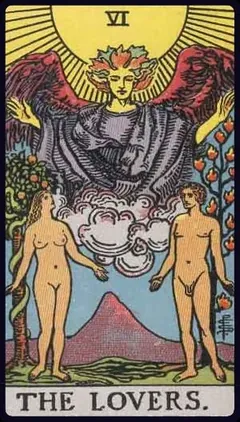
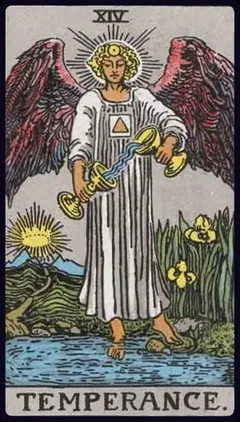
This is a symbolic reading for reflection, not a prediction: neither the Moon nor the cards decide what will happen to you.
A question for that night
If you want to use it as a reason to pause for a while, these are the questions the app suggests with The Lovers:
- What is drawing me right now, and does it align with my deepest values?
- Where am I not letting myself be fully seen by someone who matters?
- If I could choose again with open eyes, would I choose the same?
Open the meditation “Choose how to relate”
Sources and method
- Time of full moon: U.S. Naval Observatory (USNO), 14:53 UT on 24 November. aa.usno.navy.mil
- Distances: JPL Horizons (NASA), 360,765 km at full moon; perigee on 25 November around 21:08 UT, at 359,336 km. ssd.jpl.nasa.gov
- Supermoon criterion and table: Fred Espenak, AstroPixels (“Full Moon at Perigee”), relative distance 0.969. astropixels.com
- The figures on this page are computed with astronomy-engine, the same ephemeris the app uses. They agree with the sources to within about a minute for the full moon, a few minutes for perigee and around ten kilometres in distance, which is why distances are rounded. github.com