On this page
In the sky
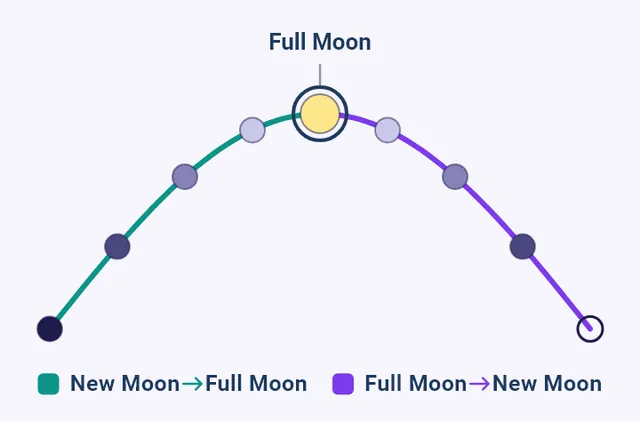
The Moon is opposite the Sun in our sky and we see its face almost completely illuminated. It rises around sunset and sets around sunrise. The exact full-Moon phase is a moment, although the disc can look full on neighbouring nights too.
Symbolic meaning
The Moon is fully lit — culmination, clarity and release. What was hidden comes to light and emotions run high; celebrate what has ripened and let go of what the light reveals.
The full circle symbolises culmination, visibility and relationship: something can now be seen in a wider context. Full Moon also has a place in the esbats of modern Wicca. In this lesson, celebration means recognising what has developed and what it reveals about your needs and connections.
Work with this phase
Read your new-Moon intention alongside what has actually happened. Record one development, one unexpected discovery and one thing still unfinished. Mark the progress with a simple gesture of gratitude or share it with someone involved. Let the review give you a clearer picture of the second half of the cycle.
Good for
- Completion
- celebration
- gratitude
- clarity
- emotional release
- manifestation.
Meditation
Avoid
- Starting long-term projects
- impulsive or binding decisions taken on high emotion.
Journal Reflections
Name what you are grateful for and what you are ready to release.
What can I see clearly now? What deserves appreciation, and what have my relationships helped me understand?
Tradition and sources
The symbolism of the eight stages draws on twentieth-century humanistic astrology. These exercises offer a personal way to work with the cycle. Here you can explore both the astronomical observations and the sources of the tradition.