
On this page
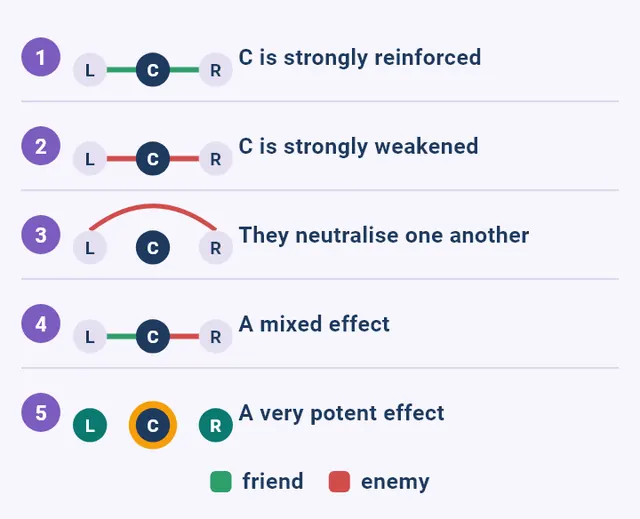
Book T gives a compact procedure for dignifying a card by the two that flank it. Label the triad Left (L) – Centre (C) – Right (R) and judge C by its neighbours. Five rules cover every case.
The five rules
- L and R share C's element, or are friends of C → C is strongly reinforced (for good or ill). Its meaning is amplified.
- L and R are both contrary to C → C is strongly weakened. Hostile flanks drain it.
- *L and R are contrary to each other → they neutralise one another* and act only weakly on C. C is read almost on its own, while the flanks "argue between themselves".
- One friendly neighbour + one hostile neighbour → a mixed effect. Nuance it: partly supported, partly resisted.
- Two cards of the same element flanking C → a very potent effect that underlines C sharply.
The subtle rule is the third. When the flanks are enemies of each other, their energies cancel before they reach the centre. But watch: two flanks can be enemies of each other and both enemies of C at the same time. Then rule 3 and rule 2 point the same way — the flanks ignore each other and squeeze the centre.
A worked triad
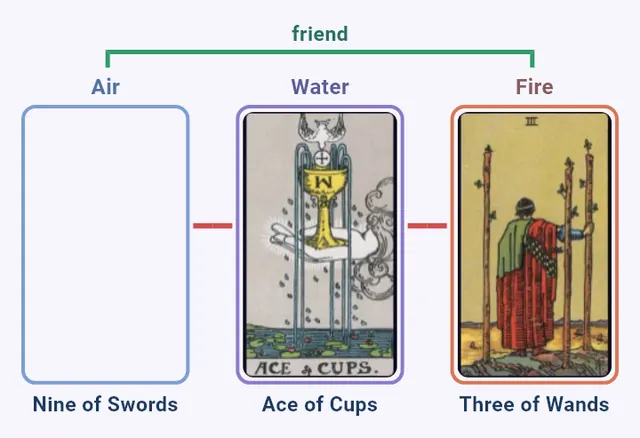
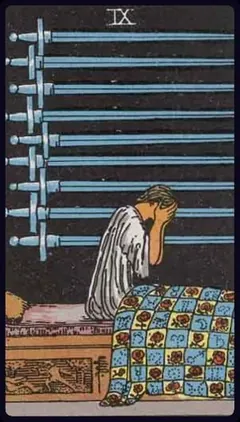
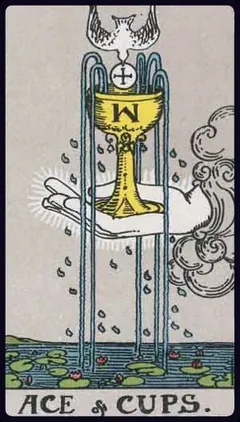
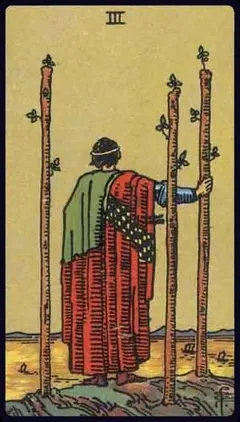
Read a Past–Present–Future line: Nine of Swords (Air) – Ace of Cups (Water) – Three of Wands (Fire).
The flanks are Air and Fire. Air and Fire are friends of each other — and both are enemies of the central Water. So the flanks reinforce one another while jointly pressing on the Ace of Cups. The centre is ill dignified.
With dignities: the emotional renewal the Ace of Cups promises is real, but it is besieged — caught between anxious, sleepless thought on one side and restless push-forward on the other. The new feeling exists, yet it struggles to open. The reading is not "no love"; it is "love trying to breathe between a racing mind and a rushing plan."
Without dignities, the same three cards read flatly as a list: "worry, then a new feeling, then expansion" — three separate beats, no tension, no story. The dignity is what turns the list into a scene.
Scaling up
In a large spread you do not dignify every card against every other. Apply dignities only to the adjacent pairs and triads that matter — the cards that touch, that sit in one line, that the question makes relevant. Trying to dignify all ten cards of a Celtic Cross at once produces noise, not insight. Choose the local neighbourhoods, dignify those, and let the rest hold their plain meanings.
Procedure
- Fix the element of L, C and R.
- Compare L and R to C (rules 1, 2, 4, 5).
- Compare L and R to each other (rule 3): do the flanks cancel?
- State whether C is reinforced, weakened, or left to speak nearly alone — then read C with that volume.
COMBINATION EXAMPLES
Key points
- 1. Rule 1 — flanks share or befriend C's element → C strongly reinforced.
- 2. Rule 2 — both flanks contrary to C → C strongly weakened.
- 3. Rule 3 — flanks contrary to each other → they neutralise and act weakly on C; C reads nearly alone.
- 4. Rule 4 — one friend + one enemy flank → mixed, nuanced effect.
- 5. Rule 5 — two same-element flanks → a very potent underline of C.
- 6. In big spreads, dignify only the adjacent pairs/triads that matter, not every card at once.
Exercises
- Lay three cards in a line. Identify which of the five rules applies, then read the centre at the volume the rule dictates.
- Build a triad where the two flanks are enemies of each other (e.g. a Wands card and a Cups card). Read the centre "nearly alone" and let the flanks argue.
- Read a triad twice: once ignoring dignities (as a list) and once applying them. Write the difference in one sentence.
- From a past reading of your own, isolate one adjacent triad and re-dignify it. Did the local meaning shift?
SOURCES & READING
- Golden Dawn — "Book T" (via Israel Regardie, "The Golden Dawn", 1937): the five triad rules for dignifying a card by its flanks.
- Benebell Wen, "Holistic Tarot" (2015): applying three-card dignities in practice.
- Mary K. Greer, "21 Ways to Read a Tarot Card" (2006): reading cards in dialogue and position.
- Rachel Pollack, "Seventy-Eight Degrees of Wisdom" (1980): narrative and context across a line of cards.