
On this page
An elemental dignity is the degree to which a card is strengthened, weakened or left roughly unchanged by the elements of the cards around it. The idea comes from the Golden Dawn's Book T, the order's tarot instruction paper preserved in Israel Regardie's The Golden Dawn. A card is never read in a vacuum: its neighbours dignify or ill-dignify it, raising or lowering how cleanly its core meaning can come through.
Every suit carries one element: Wands = Fire, Cups = Water, Swords = Air, Pentacles = Earth. From the elements come three verdicts:
- Friends / same element → well dignified. The card's meaning speaks with full force.
- Enemies → ill dignified. The meaning is weakened, distorted, or meets resistance.
- Neutrals → almost itself, with a slight shading.
The friendships are fixed. Fire and Air are friends; Water and Earth are friends. Fire and Water are enemies; Air and Earth are enemies. Fire–Earth and Air–Water are neutral to one another. There are no exceptions to memorise — just this matrix.

The flanked-card rule
Take one card and look only at its two immediate neighbours. If both are friendly or the same element, the card is well dignified. If both are hostile, it is ill dignified. If they are mixed or neutral, the card stays close to itself with a nuance. Crucially, dignity modulates — it does not replace — the base meaning. A well-dignified Five of Swords is still conflict; it simply lands sharply and effectively. An ill-dignified one is still conflict, but muddled, self-defeating, going nowhere.
One card, two neighbourhoods
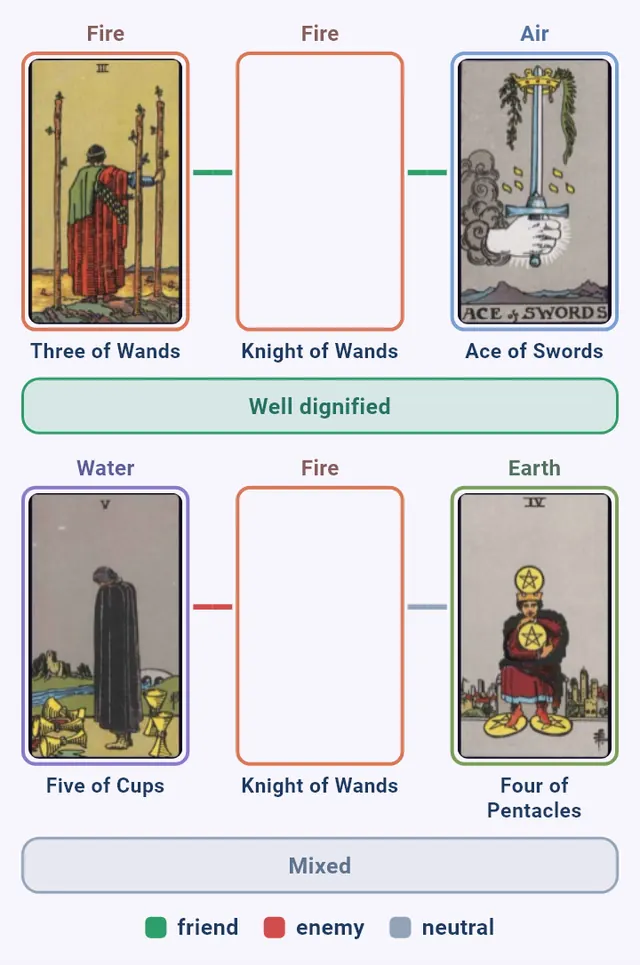
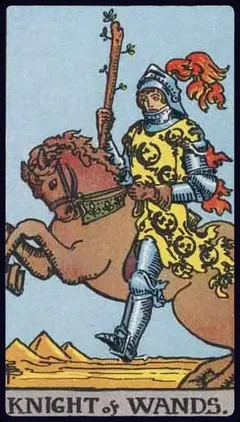
Watch a single card shift. The Knight of Wands is Fire: impulse, adventure, the leap forward.
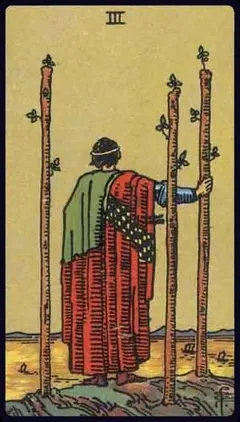
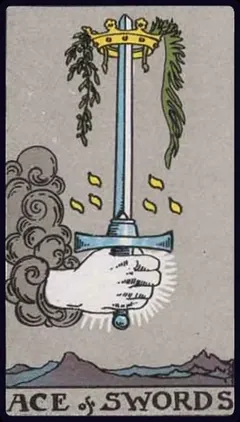
Set him between the Three of Wands (Fire) and the Ace of Swords (Air). Both are friends of Fire, so his impulse is well dignified: bold action that is also clear-sighted and lands where it aims — the leap that pays off.
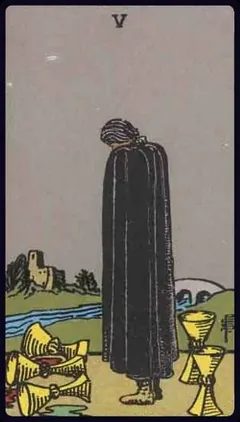
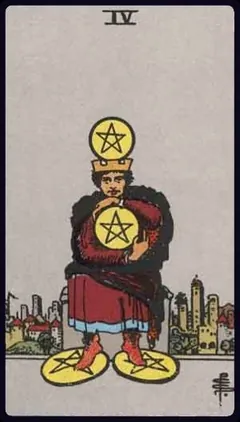
Now set the same Knight between the Five of Cups (Water) and the Four of Pentacles (Earth). Water is his enemy, but Earth is neutral to Fire, so the verdict is mixed: his impulse stays close to itself, with a nuance. The forward energy still moves, but grief drags at it on one side, while the Four's caution neither feeds nor blocks it — a leap taken less cleanly, tempted to rush past a loss that still needs tending.
The card did not change. Its neighbourhood decided how cleanly its fire could come through.
Reading order
- Read the card's base meaning first.
- Name the elements of both neighbours.
- Apply the matrix: friends, enemies or neutrals?
- Adjust the delivery of the meaning up or down — never swap the meaning for its opposite.
Dignities are a dimmer switch, not an on/off toggle. They tell you how loudly and cleanly a card gets to speak in the company it keeps.
COMBINATION EXAMPLES
Key points
- 1. A dignity strengthens, weakens or neutralises a card — it never replaces its base meaning.
- 2. Elements by suit: Wands = Fire, Cups = Water, Swords = Air, Pentacles = Earth.
- 3. Friends (same element, Fire+Air, Water+Earth) → well dignified; enemies (Fire↔Water, Air↔Earth) → ill dignified; the rest → neutral.
- 4. The flanked-card rule: judge a card by its two immediate neighbours.
- 5. Well dignified = the meaning lands clean and strong; ill dignified = weakened, distorted, resisted.
- 6. Read base meaning first, then adjust delivery up or down — a dimmer, not an on/off switch.
Exercises
- Pick any pip card. Write two one-line readings of it: one well dignified, one ill dignified. Notice the meaning stays the same — only its force changes.
- Draw three cards. Name each element aloud, then decide whether the centre card is well, ill or neutrally dignified.
- Take a card you find "negative" (e.g. Nine of Swords) and surround it mentally with two friendly elements. How does its message soften without disappearing?
- Do the reverse: surround a "positive" card with two enemy elements and describe how it becomes ill dignified.
SOURCES & READING
- Golden Dawn — "Book T" (via Israel Regardie, "The Golden Dawn", 1937): the source of elemental dignities and the friend/enemy matrix.
- Benebell Wen, "Holistic Tarot" (2015): modern practical treatment of dignities in reading.
- Robert Wang, "The Qabalistic Tarot" (1983): elemental attributions behind the Golden Dawn system.
- Rachel Pollack, "Seventy-Eight Degrees of Wisdom" (1980): reading cards in relationship and context.