
On this page
Take care of yourself
Shadow work can surface difficult emotions or memories. It is not a substitute for professional mental health care. If you feel overwhelmed, pause, ground yourself, and reach out to someone you trust or a professional. In a crisis, contact your local emergency number or a crisis helpline.
Where two shadows meet
Nowhere does the shadow become more visible than in close relationships. A partner, a parent, a dear friend—these are the people close enough to press our oldest bruises and mirror our unlived selves. Jung understood relationship as a crucible: the intimacy that heals is also the intimacy that exposes. When two people draw near, it is never only two personalities meeting. It is also two shadows, each carrying what the other has disowned.
This lesson is offered with respect. The aim is not to reduce your loved ones to symptoms of your psychology, nor to explain away real harm. It is to notice the quieter layer—the projections and triggers that live beneath the surface of a bond—so that we can love with more clarity and less blame.
Falling in love and projection
Early attraction often carries a strong charge of projection. We meet someone and feel we have "come home," that they complete us. Frequently, part of what we are responding to is our own golden shadow shining back: the freedom, warmth, or strength we long to live, glimpsed in another. This is not false—it is a real beginning—but it is partial. As the relationship matures, the projection thins, and we begin to see the actual person, distinct from the image we placed on them. Many crises of disillusion are simply this: the golden projection wearing off, asking us to love a human rather than a mirror.
Triggers as teachers
The reactions that flare in intimacy—the disproportionate hurt, the sudden contempt, the familiar spiral—are among the most honest teachers we have. A trigger is a place where the present moment has touched an old wound, often one that predates this relationship entirely. When your partner's tone lands like a blow far heavier than the words deserve, the trigger is showing you where you are still tender.
This reframing is not a demand to excuse mistreatment. Some triggers are appropriate alarms; boundaries matter. But many are invitations: this pain is mine to tend, and my partner has become the unwitting messenger. Taking responsibility for our own triggers, without collapsing into self-blame, is one of the most transforming acts in any bond.
The dance of two shadows
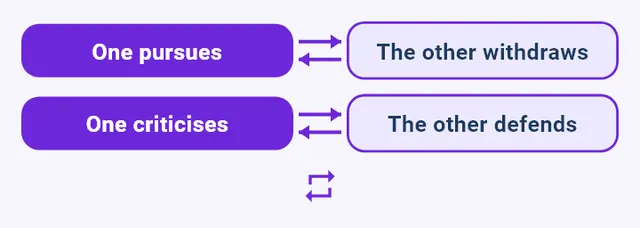
Couples often fall into a repeating choreography—one pursues, the other withdraws; one criticises, the other defends. Beneath the steps, each person is often projecting a disowned part onto the other and then reacting to it. The withdrawer may carry the other's buried need for space; the pursuer may carry the other's buried longing for closeness. The "dance" is two shadows negotiating in the dark. Seeing the pattern, rather than only the partner, is the beginning of a new step.
A note of care
Relational shadow work can stir grief, old attachment wounds, and trauma. Go slowly, and let your nervous system set the pace. This work is not a substitute for professional support, and couples' or individual therapy can be the right container when the material runs deep. Reflecting alone with tarot is valuable, but it is not a replacement for a qualified therapist when wounds reopen.
Cards for two
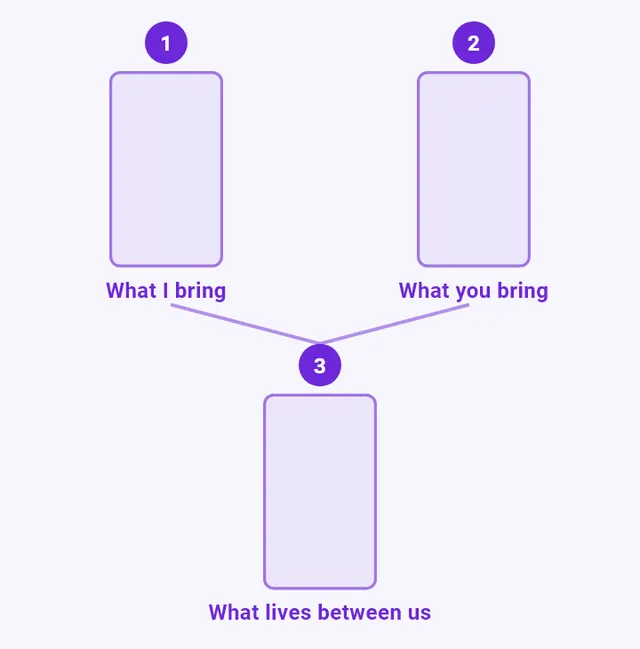
Try a simple relational spread: one card for what I bring, one for what you bring, one for what lives between us. Read the third card not as a verdict on the other person but as the shared field—the dance itself. Court cards can reveal the roles each of you slips into; a challenging card in the "between" position often names the shadow both are circling. Used gently, tarot becomes a way to talk about the unspoken with tenderness rather than accusation.
Key Points
- Close relationships make the shadow most visible: two personalities meet, but so do two shadows
- Early attraction often carries golden-shadow projection—loving the image before the person
- Triggers mark where the present has touched an old wound, often predating the relationship
- Owning our triggers without self-blame is transforming; boundaries still matter for real harm
- Repeating conflict is often a "dance" of two shadows projecting disowned parts onto each other
- A three-card relational spread can name the shared field rather than judge the partner
Exercises
- Trigger map: Recall a recent flare with someone close. Journal: "The words were ___. The pain felt older, like ___. The wound this touches is ___."
- Projection check: Name one trait that most frustrates you in a loved one. Ask honestly whether you carry a hidden or reversed version of it.
- The dance you know: Describe a repeating argument as a choreography of steps. What disowned part might each person be handing the other?
- Relational spread: Draw three cards—what I bring, what you bring, what lives between us—and journal the third as the shared field, not a verdict.
Further Reading
- Robert A. Johnson - "Owning Your Own Shadow" (1991)
- Tara Brach - "Radical Acceptance" (2003)
- Sallie Nichols - "Jung and Tarot: An Archetypal Journey" (1980)