
On this page
Take care of yourself
Shadow work can surface difficult emotions or memories. It is not a substitute for professional mental health care. If you feel overwhelmed, pause, ground yourself, and reach out to someone you trust or a professional. In a crisis, contact your local emergency number or a crisis helpline.
What projection is
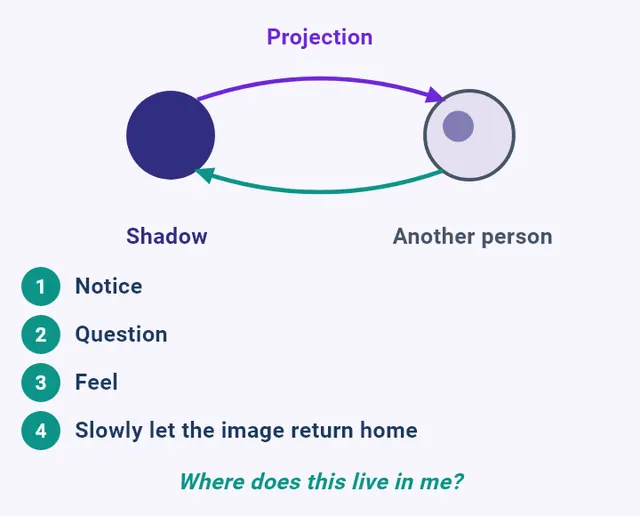
Carl Jung described projection as one of the most ordinary things the psyche does. When a quality lives in our shadow—unseen, unowned—it does not simply vanish. It looks for a screen to appear on, and the most convenient screen is another person. We meet someone who carries a fragment of our disowned material, and suddenly they seem to contain the very thing we cannot see in ourselves.
Projection is not a moral failure. It is an autonomous process, the way the unconscious tries to become visible. Jung was clear that the shadow is not evil in itself; it is simply the unlived, unacknowledged side of us. Projection is how that unlived side knocks on the door of awareness—through the faces of other people.
The emotional signature
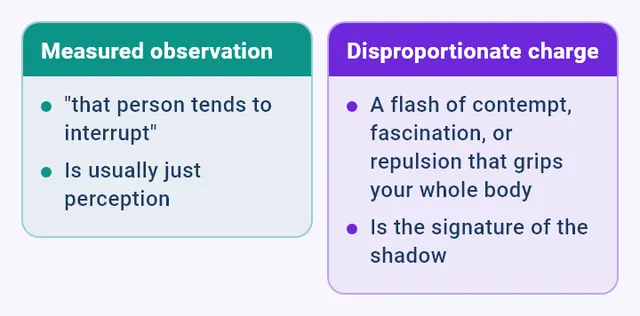
The clearest sign that you are projecting is not the content of your judgement but its intensity. A measured observation ("that person tends to interrupt") is usually just perception. A disproportionate charge—a flash of contempt, fascination, or repulsion that grips your whole body—is the signature of the shadow. When your reaction is larger than the situation warrants, some part of you is recognising itself in the mirror and refusing the recognition.
Ask yourself: does this reaction feel familiar, older than this encounter? Projections often carry the heat of childhood, of the parts we long ago learned to bury. The person in front of us has simply pressed an ancient bruise.
Withdrawing a projection
Withdrawing a projection is delicate work. It does not mean deciding the other person is innocent, or that your perceptions are worthless—sometimes people genuinely do the things we dislike. It means asking a second question: where does this live in me? The trait I condemn "out there"—the arrogance, the neediness, the coldness—where do I carry a version of it, perhaps disguised, perhaps reversed?
Robert A. Johnson taught that owning a projection returns energy to us. What we spent on judging another becomes available for living. The withdrawal is gradual: notice, question, feel, and slowly let the image return home.
This is tender territory. If a reaction opens old wounds or trauma, go slowly, and remember that deep shadow work can stir material that deserves the support of a qualified therapist. Reclaiming a projection is not about forcing insight—it is about telling the truth to yourself with kindness.
Cards as mirrors
Tarot is a field of ready-made screens. The court cards especially invite projection: the Knight who seems reckless, the Queen who seems cold, the King who seems tyrannical. When a card provokes a strong verdict, treat that verdict as a mirror. Ask the card, "What in me are you showing?" The reversed cards, too, often surface the disowned angle of a familiar image. The reading becomes less a prediction and more a conversation with the parts of yourself you meet first in others.
Key Points
- Projection is an autonomous, ordinary process—the unconscious becoming visible on the screen of another person
- The signature of projection is disproportionate intensity, not the content of the judgement
- A charged reaction often carries an old, childhood heat—an ancient bruise being pressed
- Withdrawing a projection means asking "where does this live in me?"—not declaring the other innocent
- Owning a projection returns energy that was being spent on judgement
- Court cards and reversals are natural mirrors for disowned traits in a reading
Exercises
- Intensity log: For a week, note each moment a reaction feels "too big." Write the trigger, the trait you condemned, and the age the feeling seems to come from.
- The mirror question: Take one person who strongly irritates you. In your journal, complete: "The trait I reject in them is ___. A hidden or reversed version of it in me is ___."
- Court-card mirror: Draw a court card, voice your immediate verdict on it, then ask "What in me are you showing?" and write the reply.
- Return of energy: Recall a projection you have already withdrawn. Note what became possible once the judgement softened.
Further Reading
- Robert A. Johnson - "Owning Your Own Shadow" (1991)
- C.G. Jung - "The Archetypes and the Collective Unconscious" (1959)
- Sallie Nichols - "Jung and Tarot: An Archetypal Journey" (1980)