
Understanding the card
Its symbolic meaning
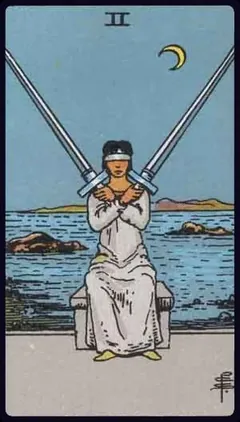
The Two of Swords represents difficult choices and stalemate. Blindfolded and holding two swords creates uncomfortable balance. Avoiding a decision brings temporary peace but resolution requires facing the truth and making a choice despite uncertainty.
What this meditation explores
The crossed blades and covered eyes create a balance maintained through closure. Meditation explores what a suspended decision protects, and how a limited opening to information could make movement possible without forcing an immediate verdict.
Elements to contemplate
Blindfold: avoiding truth. Two crossed swords: balanced opposition. Water behind: emotions blocked.
Rider–Waite–Smith symbolism · Waite (1910/1911). Contemporary contemplative approach: Vialunis. Sources below.
Preparation
Sit comfortably with this card visible. Keep your eyes open and breathe naturally. The symbols described come from the Rider–Waite–Smith deck; if your deck differs, use that description as a reference. Spend a quiet interval with each question. You may repeat a step, pause or stop; no answer is required.
Steps
- Feel the support beneath your body. Look at the whole card, then recall a manageable situation related to this intention. You do not need to revisit your hardest experience.
- Notice the crossed swords and covered eyes: balance can also keep things closed.
- What are you protecting by not deciding, and what information are you avoiding?
- Choose one manageable fact to examine without forcing the whole decision.
- Return your attention to the room and move gently. Notice what remains with you, even if no answer appeared. You can return to this practice whenever useful.
Closing
Return your attention to the room and move gently. Notice what remains with you, even if no answer appeared. You can return to this practice whenever useful.
For your note
Choose one manageable fact to examine without forcing the whole decision.
Grounding: Symbolism: Rider–Waite–Smith, Pamela Colman Smith's images and A. E. Waite's commentary (1910/1911). Method: contemporary guided contemplation. Waite suggests individual reflection on the major trumps in Part II §3; applying this five-step format to this card is the app's own adaptation, not a historical ritual.
Sources
- A. E. Waite, The Pictorial Key to the Tarot (1910/1911), III §2: Two of Swords. Pamela Colman Smith (1909).
- Method: look at the card, reflect quietly, then consider a small personal action. The prompts are original; the cited source supports the symbolism.