
Understanding the card
Its symbolic meaning
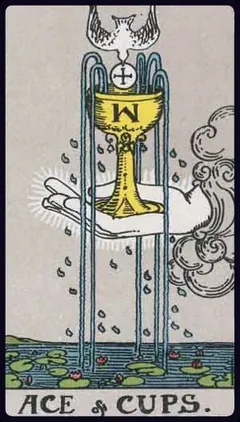
The Ace of Cups represents new emotional beginnings and spiritual awakening. Love, compassion, and intuition overflow. Open your heart to new relationships, creative inspiration, or deeper spiritual connection.
What this meditation explores
The overflowing vessel presents feeling as something received before it can be explained. Meditation makes room for an emerging emotion, attending to its felt quality while allowing its meaning to develop gradually.
Elements to contemplate
Overflowing cup: abundant emotions. Dove with wafer: Holy Spirit and divine love. Five streams: five senses awakened.
Rider–Waite–Smith symbolism · Waite (1910/1911). Contemporary contemplative approach: Vialunis. Sources below.
Preparation
Sit comfortably with this card visible. Keep your eyes open and breathe naturally. The symbols described come from the Rider–Waite–Smith deck; if your deck differs, use that description as a reference. Spend a quiet interval with each question. You may repeat a step, pause or stop; no answer is required.
Steps
- Feel the support beneath your body. Look at the whole card, then recall a manageable situation related to this intention. You do not need to revisit your hardest experience.
- Notice the overflowing cup: feeling may arrive before a clear explanation.
- What sensation is beginning, without deciding yet what it means?
- Give it a simple name and room to change without demanding a conclusion.
- Return your attention to the room and move gently. Notice what remains with you, even if no answer appeared. You can return to this practice whenever useful.
Closing
Return your attention to the room and move gently. Notice what remains with you, even if no answer appeared. You can return to this practice whenever useful.
For your note
Give it a simple name and room to change without demanding a conclusion.
Grounding: Symbolism: Rider–Waite–Smith, Pamela Colman Smith's images and A. E. Waite's commentary (1910/1911). Method: contemporary guided contemplation. Waite suggests individual reflection on the major trumps in Part II §3; applying this five-step format to this card is the app's own adaptation, not a historical ritual.
Sources
- A. E. Waite, The Pictorial Key to the Tarot (1910/1911), III §2: Ace of Cups. Pamela Colman Smith (1909).
- Method: look at the card, reflect quietly, then consider a small personal action. The prompts are original; the cited source supports the symbolism.