
On this page
The same cards, a different meaning
No combination has a fixed meaning until you know two things the cards themselves cannot tell you: where they fell and what was asked. Position and question are not decorations around the reading — they are modifiers as powerful as any elemental neighbour. Change either one and the same two cards can say something new.
Position is a modifier
Every spread assigns each slot a job — this is the obstacle, this is the advice, this is the outcome. You already meet these jobs in the Spreads course, so we will not re-teach them here; the point is that the slot rewrites the card. The Ten of Swords in an "outcome" position warns of a painful ending; the same card in a "root of the problem" position says the ending has already happened and the querent is living in its aftermath. The card did not change — its office did.
The question is a filter
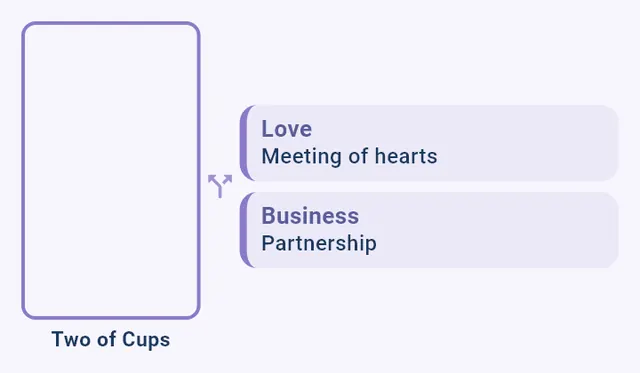
The question decides which layer of a card is relevant. The Two of Cups in a love reading is a meeting of hearts; the same Two of Cups over a business question is a partnership, a signed agreement, a fair deal. Nothing in the image changed; the question filtered the meaning toward the room it belongs to.
An order of operations
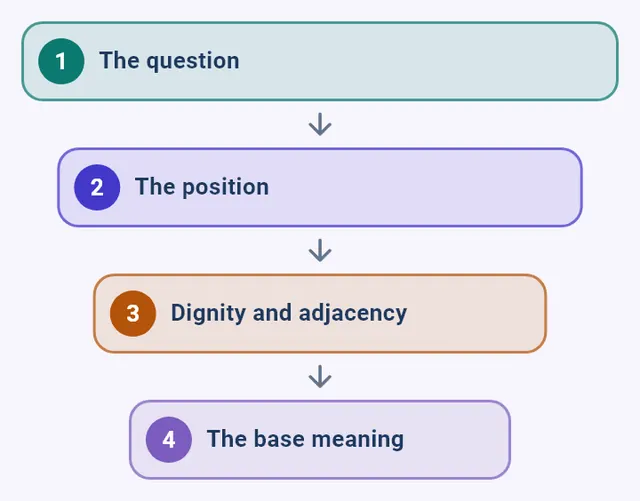
Because so many modifiers stack, it helps to interpret in a fixed order, from the most contextual to the most general:
- The question — what was actually asked, and in what domain.
- The position — the job this slot does in the spread.
- Dignity and adjacency — how the neighbours and their elements push or soften the card.
- The base meaning — the card's own core, read last and through all the filters above.
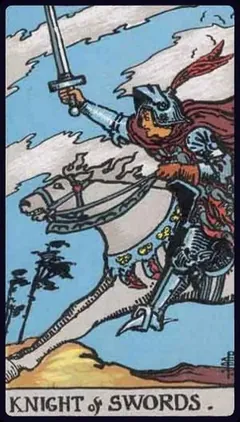
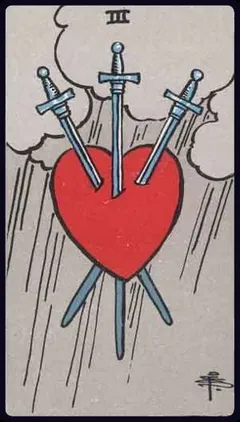
Watch a single card move through these. Knight of Swords in a "counsel" position says: act with decision, cut cleanly, do not dither. The very same Knight in a "how others see you" position says: they perceive you as aggressive, blunt, too fast with words. And the same Knight set beside the Three of Swords — Air beside Air, the strongest same-element reinforcement — becomes words that wound: a sharp mind and a heartbreak amplifying each other into intense mental conflict, arguments that cut. One card, three readings, decided entirely by context.
The bias to guard against
This power to reframe is also a trap. It is easy to bend a combination toward the answer you already want — to call a hard card "transitory" because you hope it is, or to read advice as prophecy. Confirmation bias hides inside interpretation. The guard is honesty about the order above: let the question and the position speak before your wish does, and be willing to read a card in a way you do not like.
In practice
Before deciding what a pair means, say the question and the position aloud. Only then bring in dignity, and only last the base meaning. The discipline is dull, and it is exactly what keeps a reading true.
COMBINATION EXAMPLES
Key points
- Position and question are modifiers as strong as any elemental neighbour.
- The slot rewrites the card: an "outcome" Ten of Swords and a "root" Ten of Swords say different things.
- The question filters meaning: Two of Cups reads differently in love than in business.
- Interpret in order: question → position → dignity and adjacency → base meaning.
- Guard against confirmation bias: let the question and position speak before your wish does.
Exercises
- Take one card and read it in three different spread positions; write how its meaning shifts each time.
- Ask the same two-card pair against a love question and a work question and note what changes.
- On your next reading, say the question and position aloud before you touch the base meaning.
SOURCES & READING
- Mary K. Greer, 21 Ways to Read a Tarot Card (2006)
- Benebell Wen, Holistic Tarot (2015)
- Anthony Louis, Tarot Plain and Simple (1996)
- Rachel Pollack, Seventy-Eight Degrees of Wisdom (1980)