
On this page
Three ways to meet a court card
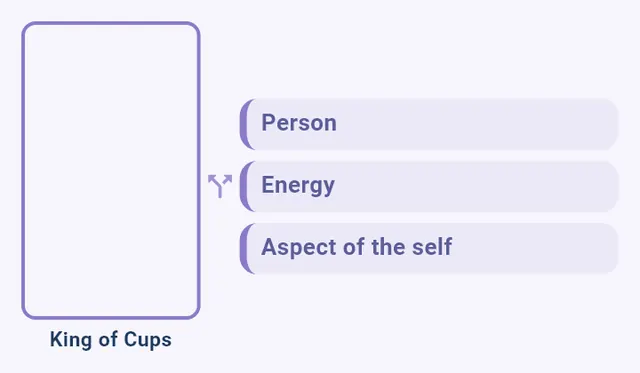
The sixteen court cards are the hardest family in the deck because each one can be read three ways: as a person in the querent's life, as an energy or quality in the air, or as an aspect of the self. None of these is the "right" one; the reading and the question decide. A King of Cups may be a specific mature man, or the quality of emotional mastery the situation calls for, or a part of the querent learning to hold their own feelings. Keep all three live until the spread tells you which.
The ladder of maturity
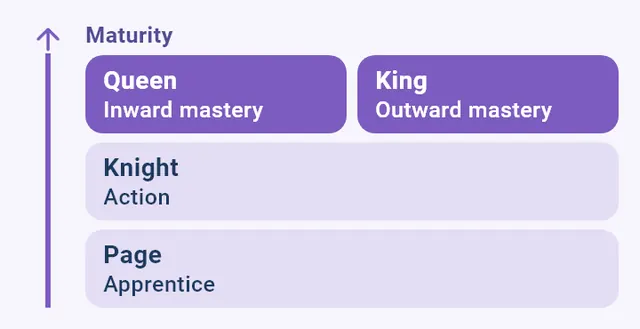
The four ranks form a ladder of maturity and stance. Page (or Knave) is the apprentice and the messenger: beginning, learning, news arriving. Knight is action taken to the extreme: movement, zeal, the energy in its most one-directional and least balanced form. Queen is inward mastery: she holds the element receptively, from within, with depth. King is outward mastery: he wields the element actively, in the world, with authority. Page and Knight are the element still forming; Queen and King are the element matured, turned inward or outward.
Courts in conversation
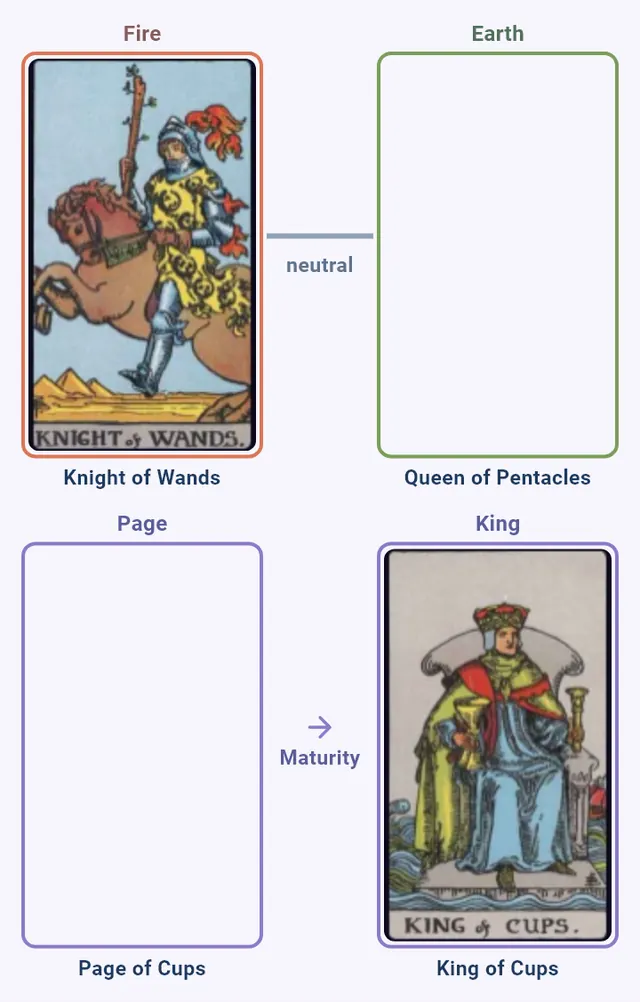
When several courts appear, read them as a conversation between people or parts, combining maturity (the rank) with element (the suit — and therefore the dignities you already know). Two examples show the two axes.
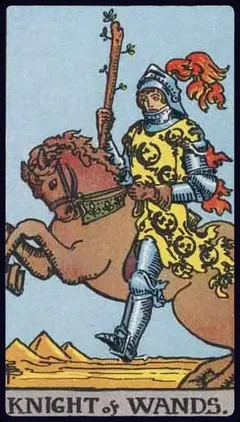
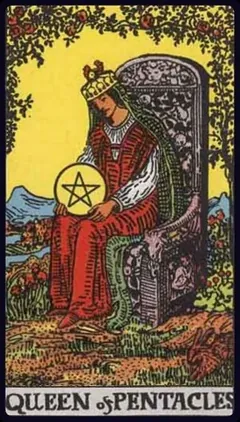
Knight of Wands + Queen of Pentacles crosses the axes fully: impulsive Fire beside steady, practical Earth. A word of rigor first — by strict elemental dignity, Fire and Earth are neutral, neither friends nor enemies, so this is not a weakening dignity. The friction here is one of temperament, not of element: the Knight's headlong, all-or-nothing charge against the Queen's grounded, responsible patience. One wants to act now; the other wants to tend what already exists. Read as parts of a person, it is the classic pull between reckless momentum and calm stewardship.
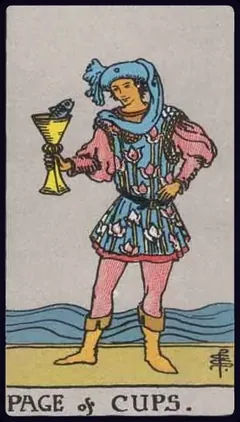
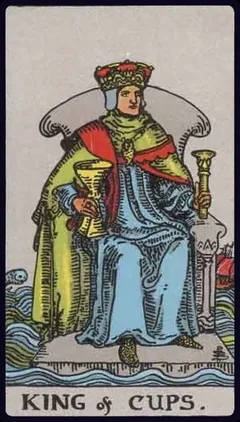
Page of Cups + King of Cups holds the element steady and moves along the ladder instead: same suit, opposite maturity. This is the emotional journey from beginner to master — the Page's tender, easily-moved, first feeling, and the King's contained, weathered command of the same water. Together they can read as a single arc: where the querent's heart is starting, and where it is being invited to grow.
Which court are you?
Because courts are so personal, they are also the doorway into your own patterns. The Personal Tarot course asks which court card you most resemble — a useful mirror to bring here, because knowing your default rank and element tells you which voice in a spread is likely you.
In practice
When two or more courts fall together, name each one's rank and element, then stage the dialogue: who is younger, who is older, whose element feeds or cools whose. You will carry this straight into the Complete readings course, where crowded spreads full of people are worked in full.
COMBINATION EXAMPLES
Key points
- Read each court three ways — a person, an energy, an aspect of the self — and let the spread decide.
- The ranks are a maturity ladder: Page/Knave (apprentice), Knight (extreme action), Queen (inner mastery), King (outer mastery).
- Several courts together are a conversation; combine each one's maturity with its element.
- Knight of Wands + Queen of Pentacles clash by temperament, not dignity — Fire and Earth are elementally neutral.
- Page of Cups + King of Cups share the element but span the ladder: the same heart from beginner to master.
Exercises
- Pull the four courts of one suit and say aloud how the same element matures from Page to King.
- For two courts in a spread, name each one's rank and element, then stage a short dialogue between them.
- Decide which court card you most resemble, and notice its voice when it appears in your own readings.
SOURCES & READING
- Golden Dawn, "Book T" (in Israel Regardie, The Golden Dawn, 1937)
- Benebell Wen, Holistic Tarot (2015)
- Anthony Louis, Tarot Plain and Simple (1996)
- Mary K. Greer, 21 Ways to Read a Tarot Card (2006)
- Rachel Pollack, Tarot Wisdom (2008)