
On this page
- Two systems, one word
- Where the idea comes from
- The four essential dignities
- The table of the seven classical planets
- Why a tarot reader should care
- Example 1 — The Tower and the force of Mars
- Example 2 — The Moon and Mercury's fall
- A subtler pass — the Wheel and the Devil
- The planetary Majors at a glance
- How to use dignities in a reading
- Key Points
- Tarot Correspondences
- Further Reading
Every planet has places in the zodiac where it feels at home and places where it feels like a stranger. Traditional astrologers mapped this with a system called essential dignity. For a tarot reader who works with the Golden Dawn planet-and-sign attributions, essential dignity is a precise tool: it tells you how strong or how strained a planetary energy is when it appears in a card.
Two systems, one word
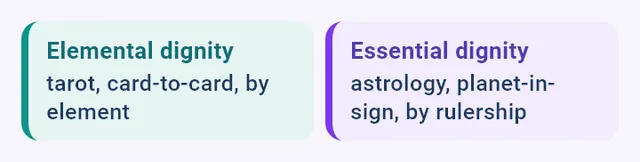
First, a warning that saves confusion. In the Combinations course you met elemental dignities — a purely tarot technique where neighbouring cards strengthen or weaken each other by element (Fire dislikes Water, Air agrees with Fire, and so on).
Essential dignities are a different, older, astrological system. They describe the relationship between a planet and the zodiac sign it occupies. They have nothing to do with which cards happen to sit next to each other on the table. Keep the two ideas in separate drawers:
- Elemental dignity = tarot, card-to-card, by element.
- Essential dignity = astrology, planet-in-sign, by rulership.
This lesson is only about the second.
Where the idea comes from
The scheme is ancient. It was systematised in the 2nd century by Claudius Ptolemy in the Tetrabiblos, refined through the Persian and medieval Arabic tradition, and reached English readers through William Lilly's Christian Astrology (1647), still the classic manual. When the Golden Dawn built the modern esoteric tarot in the 1890s, they inherited this whole planetary logic and welded it onto the deck. So when you use dignity at the tarot table you are not bolting on a foreign idea — you are reading the cards with the same grammar their designers assumed.
The four essential dignities
Classical astrology recognises several dignities; the four you meet first are the strongest and the weakest:
- Domicile (rulership) — the planet is at home. It acts with full, natural authority. This is its own sign.
- Exaltation — the planet is an honoured guest. Its energy is elevated, idealised, shown at its best.
- Detriment — the planet sits in the sign opposite its domicile. It is a stranger far from home: uneasy, working against the grain.
- Fall — the planet sits in the sign opposite its exaltation. It is dishonoured, weakened, its expression muted or awkward.
Notice the elegant symmetry: detriment is always the sign opposite a planet's home, and fall is always the sign opposite its exaltation. If you know the strong placements, the weak ones are simply the signs across the wheel.
The table of the seven classical planets
Traditional dignity uses the seven visible "planets" (including the Sun and Moon). Here is the complete map:
| Planet | Domicile | Detriment | Exaltation | Fall |
|---|---|---|---|---|
| Sun ☉ | Leo | Aquarius | Aries | Libra |
| Moon ☽ | Cancer | Capricorn | Taurus | Scorpio |
| Mercury ☿ | Gemini & Virgo | Sagittarius & Pisces | Virgo | Pisces |
| Venus ♀ | Taurus & Libra | Scorpio & Aries | Pisces | Virgo |
| Mars ♂ | Aries & Scorpio | Libra & Taurus | Capricorn | Cancer |
| Jupiter ♃ | Sagittarius & Pisces | Gemini & Virgo | Cancer | Capricorn |
| Saturn ♄ | Capricorn & Aquarius | Cancer & Leo | Libra | Aries |
A couple of details worth memorising. Mercury is unusual: Virgo is both its domicile and its exaltation, and Pisces is both its detriment and its fall. That double weighting is why Mercury's virtues — analysis, discrimination, language — collapse so completely in the Piscean, boundary-dissolving direction. Venus is exalted in Pisces (love raised to compassion) and falls in Virgo, where critical analysis chills feeling.
Why a tarot reader should care
The Golden Dawn assigned a planet or a sign to every Major Arcanum and to the court and pip cards. Once a card carries a planet, that planet is somewhere in the zodiac, and essential dignity tells you the emotional temperature of that placement.
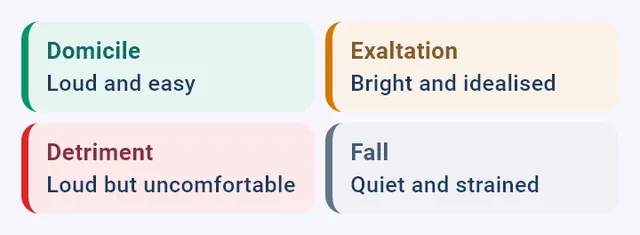
Think of it as a volume-and-comfort dial. The same planet can be:
- Loud and easy (domicile),
- Bright and idealised (exaltation),
- Loud but uncomfortable (detriment),
- Quiet and strained (fall).
You are not inventing new card meanings. You are inflecting the meaning a card already has, using the dignity of the planet the Golden Dawn already gave it.
Example 1 — The Tower and the force of Mars
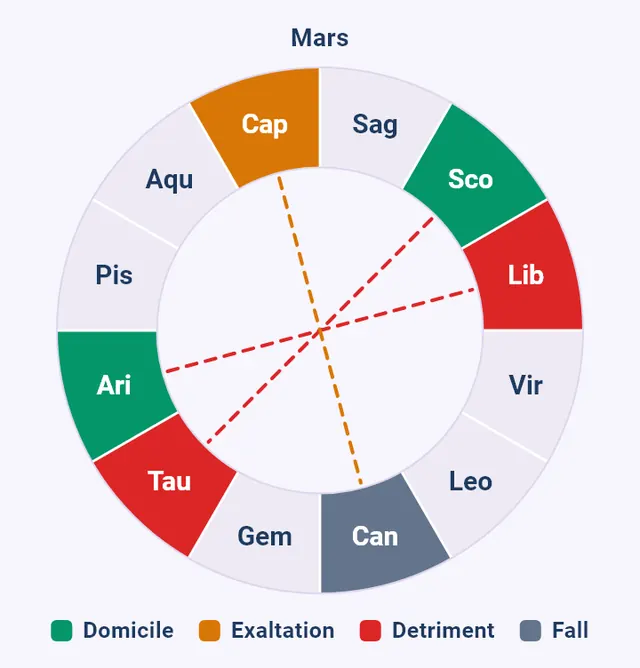
The Tower (XVI) is ruled by Mars, the planet of action, severance, war and sudden force. Its dignity map tells you where that force is clean and where it turns destructive:
- In Aries or Scorpio (domicile) Mars is decisive and surgical — the Tower as a necessary demolition.
- In Capricorn (exaltation) Mars is disciplined ambition — collapse that clears the way for a stronger structure.
- In Libra or Taurus (detriment) Mars is thwarted — the Tower as frustration, forced compromise, a blow you cannot answer.
- In Cancer (fall) Mars is raw and wounded — the Tower as an emotional eruption, reactive rather than clarifying.
So when the Tower appears, ask what kind of Mars the rest of the spread is describing. Martial energy at home cuts cleanly; Martial energy in fall lashes out. The card is the same; its temperature is not.
Example 2 — The Moon and Mercury's fall
The Moon (XVIII) is attributed to Pisces. And Pisces, as the table shows, is exactly where Mercury falls.
This is beautifully expressive. Mercury is the mind: logic, speech, measurement, the daylight intellect. In Pisces that faculty is dishonoured — not destroyed, but subordinated. The rational mind loses its footing in the tidal, dreamlike waters of the Moon card.
Read positively, this is the whole point of card XVIII: it asks you to trust intuition over analysis, image over argument, the felt sense over the spreadsheet. The "weakness" of Mercury here is precisely why the Moon is the card of dreams, illusions, psychic tides and things that cannot be said plainly. When the Moon appears beside a very "mental" card, essential dignity gives you the instruction: stop trying to reason it out.
A subtler pass — the Wheel and the Devil
For a deeper read, follow Jupiter. The Wheel of Fortune (X) is Jupiter's card: expansion, luck, growth, providence. Jupiter is exalted in Cancer and falls in Capricorn.
Now look at the Devil (XV), attributed to Capricorn. Capricorn is where Jupiter falls and where Mars is exalted. So the Devil carries a double signature: Jupiter constrained (growth turned to materialism, generosity turned to appetite) and Mars honoured (cold, effective, ambitious will). That is a remarkably exact portrait of the card — bondage that is also, uncomfortably, a form of disciplined power.
The planetary Majors at a glance
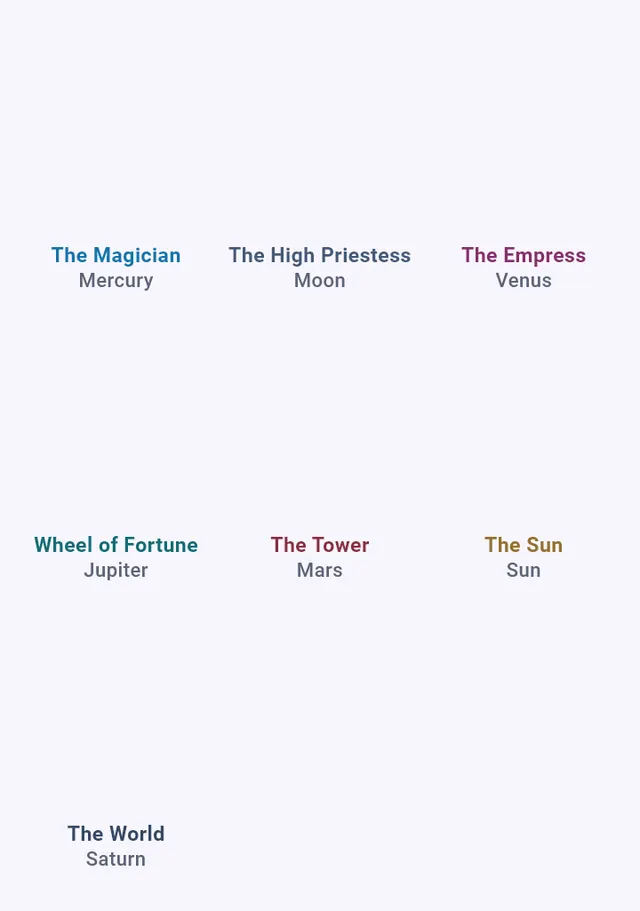
Seven Majors carry a classical planet directly — these are the cards where essential dignity bites hardest:
- The Magician — Mercury
- The High Priestess — Moon
- The Empress — Venus
- Wheel of Fortune — Jupiter
- The Tower — Mars
- The Sun — Sun
- The World — Saturn
For each, the four dignities tell you the card's possible registers. The Empress (Venus) glows in her Piscean exaltation as unconditional love, but can chill toward Virgoan fall as anxious perfectionism about those she nurtures. The World (Saturn) stands proud in its Libran exaltation — mastery, completion, just boundaries — and strains toward its Arien fall, where structure becomes premature or brittle.
How to use dignities in a reading
You do not need a birth chart. Work like this:
- Identify the planet or sign the Golden Dawn gives the card.
- If it is a planet-ruled card, recall that planet's dignities — its home, its exaltation, its detriment, its fall.
- Let the surrounding cards, the question, and the querent's context suggest which zodiacal mood is active.
- Inflect, don't overwrite. Dignity turns the volume up or down; it never changes the song.
A final caution against fatalism. A planet in fall is not a verdict of failure. Traditional astrologers read fall and detriment as effort — energy that must work harder, without the easy home advantage. The Moon's fallen Mercury is not a broken mind; it is a mind asked to be quiet so that something deeper can speak. Read dignity as conditions, never as fate.
Key Points
- Essential dignity = an astrological planet-in-sign system; not the same as tarot's elemental dignities (card-to-card).
- The four dignities: domicile (home), exaltation (honoured), detriment (opposite the home), fall (opposite the exaltation).
- Detriment is always opposite domicile; fall is always opposite exaltation — the weak placements mirror the strong.
- Mercury doubles up in Virgo (domicile + exaltation) and Pisces (detriment + fall); Venus is exalted in Pisces, falls in Virgo.
- Dignity inflects a card's Golden Dawn planet — the same planet reads loud-easy, bright, uneasy, or strained.
- Read fall and detriment as effort and conditions, never as fate: no fatalism.
Tarot Correspondences
- The Tower (Mars): the martial force — clean in Aries/Scorpio, wounded in Cancer (fall).
- The Moon XVIII (Pisces): carries Mercury's fall — trust intuition over logic.
- The Devil (Capricorn): Jupiter's fall + Mars' exaltation — disciplined power that also binds.
- The Empress (Venus): exalted in Pisces (unconditional love), falls in Virgo (anxious perfectionism).
- The World (Saturn): exalted in Libra (just mastery), falls in Aries (brittle, premature structure).
- The Sun XIX (Sun): domicile Leo, exaltation Aries — radiant vitality; detriment Aquarius, fall Libra dim it.
Further Reading
- William Lilly — Christian Astrology (1647), the classic English manual on essential dignities.
- Deborah Houlding — The Houses: Temples of the Sky, for the traditional framework of rulerships.
- Golden Dawn — Book T, the source of the planet-and-sign attributions used in modern tarot.