
On this page
Introduction
The story of tarot begins not in mystical temples or occult societies, but in the Renaissance courts of northern Italy. In the mid-15th century, wealthy families commissioned beautifully hand-painted card decks for a game called "tarocchi" or "trionfi" (triumphs). These were not tools of divination, but luxury playing cards that would eventually evolve into the tarot we know today.
The Birth of Tarocchi
Around 1440, in the courts of Milan, Ferrara, and Bologna, a new type of card deck appeared. Standard playing cards (similar to modern playing cards with four suits) had already existed in Europe since the late 14th century, likely imported from the Islamic world via trade routes. But Italian nobles wanted something more elaborate—something that would display their wealth, education, and cultural sophistication.
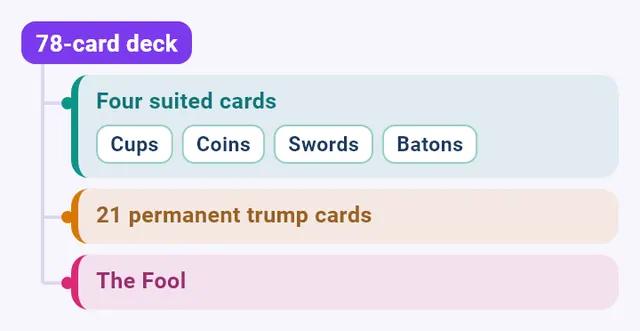
The innovation was simple but significant: in addition to the four suited cards (similar to Cups, Coins, Swords, and Batons), artists added a fifth suit of 21 permanent trump cards plus one special card called "The Fool." These trump cards depicted allegorical images: virtues, planets, social roles, and religious themes. Together with the original four suits, this created a 78-card deck.
The Visconti-Sforza Decks
The oldest surviving tarot decks are the Visconti-Sforza decks, commissioned by the Duke of Milan and painted by renowned artists like Bonifacio Bembo around 1450. These hand-painted masterpieces on gold-leaf backgrounds were status symbols, commissioned for weddings and celebrations.
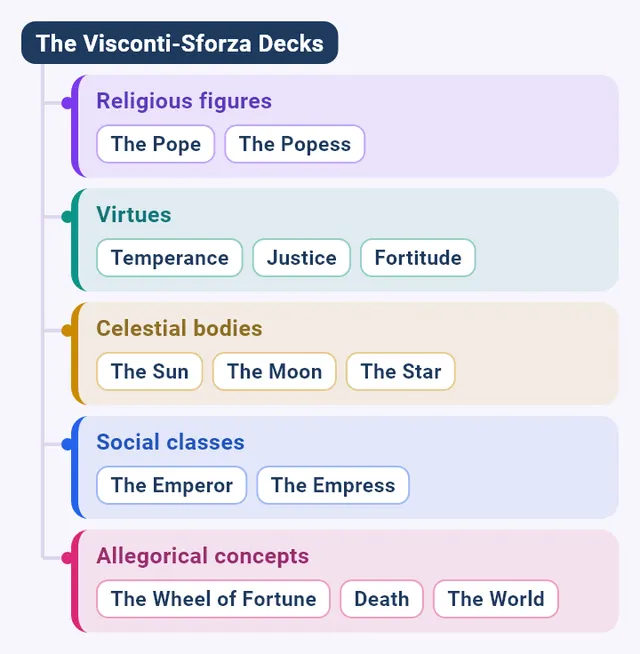
The imagery on these early cards reflected the worldview of Renaissance Italy: religious figures (The Pope, The Popess), virtues (Temperance, Justice, Fortitude), celestial bodies (The Sun, The Moon, The Star), social classes (The Emperor, The Empress), and allegorical concepts (The Wheel of Fortune, Death, The World).
Tarot as a Game
For the next 300 years, tarot remained primarily a game—a sophisticated trick-taking game similar to bridge, played throughout France, Italy, Switzerland, and parts of Germany. Different regions developed their own variations: the French "Tarot de Marseille," the Italian "Tarocco Piemontese," the Swiss "1JJ" deck.
The game was purely recreational. There is no historical evidence of tarot being used for divination before the late 18th century. This is a critical fact often obscured by modern misconceptions about tarot's "ancient origins."
Key Distinctions
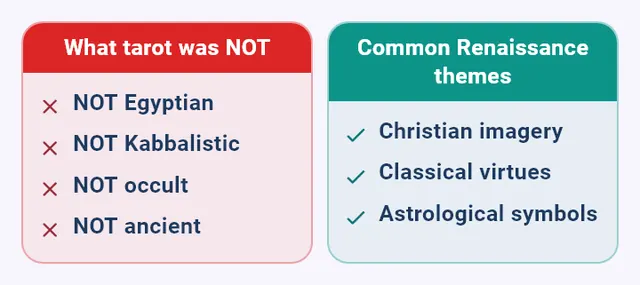
It's important to understand what tarot was NOT in the 15th-16th centuries:
- NOT Egyptian: Claims of Egyptian origins are 19th-century inventions
- NOT Kabbalistic: Jewish mysticism connections came much later
- NOT occult: The cards had no association with magic or fortune-telling
- NOT ancient: Tarot is a Renaissance creation, not prehistoric
The cards depicted common Renaissance themes—Christian imagery, classical virtues, astrological symbols—all familiar to educated Europeans of the time.
The Evolution Begins
By the 1700s, the Tarot de Marseille had become the dominant pattern, especially in France. It was a woodblock-printed, mass-produced deck (no longer hand-painted luxury items) used widely for gaming. This standardized structure—22 Major Arcana and 56 Minor Arcana—would become the template for nearly all future tarot decks.
But it wasn't until the late 18th century that French occultists began to look at these gaming cards and imagine esoteric meanings hidden within them. That transformation—from game to spiritual tool—is the subject of later lessons.
Conclusion
Understanding tarot's mundane origins as luxury playing cards grounds us in historical reality. The tarot was not handed down from ancient priests or mystical sages. It was created by Italian artists and cardmakers for entertainment. This doesn't diminish its spiritual power today—rather, it shows how human creativity, art, and cultural meaning-making can transform simple objects into profound tools for insight.
The cards' longevity and evolution from game to divination tool is a testament to their rich symbolic vocabulary and archetypal power—qualities that were inherent in the Renaissance imagery from the very beginning.
Key Points
- Tarot originated in 15th-century Italian Renaissance courts as luxury playing cards
- The game was called "tarocchi" or "trionfi" (triumphs)
- The 78-card structure: 56 suited cards + 21 trumps + The Fool
- Oldest surviving decks: Visconti-Sforza (c.1450), hand-painted for nobility
- Used exclusively as a game for 300+ years—not for divination
- Claims of Egyptian, Kabbalistic, or ancient occult origins are false
- Tarot de Marseille became the standardized pattern by the 1700s
- The transformation to spiritual tool came in the late 18th century
Traditional Sources
- Dummett, Michael. "The Game of Tarot" (1980) - Authoritative history
- Kaplan, Stuart R. "The Encyclopedia of Tarot, Vol. 1" (1978)
- Place, Robert M. "The Tarot: History, Symbolism, and Divination" (2005)
Further Reading
- Visit museums with Visconti-Sforza cards: Pierpont Morgan Library, Accademia Carrara
- Read "A Wicked Pack of Cards" by Decker, Depaulis, and Dummett
- Explore the International Playing Card Society archives