
On this page
Introduction
Before there was Rider-Waite-Smith, before Aleister Crowley's Thoth, before modern psychological tarot—there was the Tarot de Marseille (TdM). This is the oldest continuous tarot tradition, with roots stretching back to the 17th century and standardized patterns from the early 18th century. For over 300 years, the TdM was THE tarot deck of Europe, used for gaming and, later, divination.
While visually simpler than the illustrated RWS, the Marseille tradition offers a profoundly different approach to tarot: one rooted in elemental imagery, geometric symbolism, archetypal essentialism, and direct intuitive response to color, number, and pattern. Understanding the TdM opens doorways to pre-modern tarot wisdom and offers an alternative lens through which to interpret the cards.
Historical Origins
The term "Tarot de Marseille" doesn't refer to a single deck but to a family of decks sharing common visual structures. The pattern emerged in the 17th century from Italian tarot traditions and was standardized by cardmakers in Marseille, France—a major printing and exporting hub.
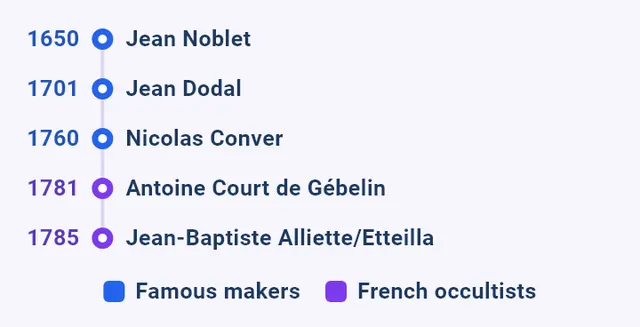
By the 1700s, the Marseille pattern dominated French, Italian, and Swiss tarot production. Famous makers like Nicolas Conver (1760), Jean Dodal (1701), and Jean Noblet (1650) created influential versions that became templates for later decks.
Key historical points:
- Used primarily for gaming (the tarot card game) for 200+ years
- No association with divination until the late 18th century
- Pre-dates all occult tarot systems (Golden Dawn, Thoth, RWS)
- Represents the "pure" tarot before esoteric overlays
When French occultists like Antoine Court de Gébelin (1781) and Jean-Baptiste Alliette/Etteilla (1785) began using tarot for divination, they worked with Marseille-pattern decks, layering new meanings onto old imagery.
Visual Structure and Symbolism
The TdM's visual language is strikingly different from RWS:
1. Unillustrated Minor Arcana
Unlike RWS, the Minor Arcana (numbered cards 1-10 in each suit) show only the suit symbols arranged geometrically. The Three of Cups displays three cups; the Seven of Swords shows seven swords. There are no human figures, no narrative scenes, no obvious "story" to interpret.
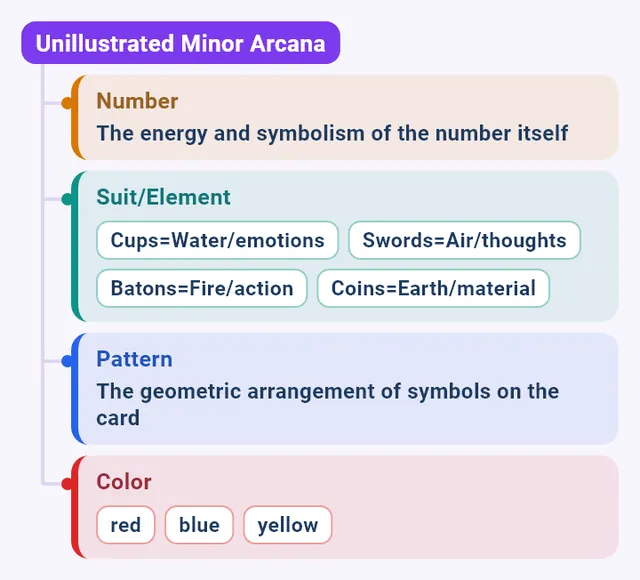
This minimalism is not a limitation—it's a feature. Without prescribed narratives, readers respond directly to:
- Number: The energy and symbolism of the number itself (1=beginnings, 7=challenge, 10=completion)
- Suit/Element: The elemental quality (Cups=Water/emotions, Swords=Air/thoughts, Batons=Fire/action, Coins=Earth/material)
- Pattern: The geometric arrangement of symbols on the card
- Color: Bold primary colors (red, blue, yellow) and their psychological/spiritual resonance
The lack of illustration invites deeper engagement with numerology, elemental theory, and intuitive sight.
2. Bold, Primary Colors
TdM uses flat blocks of bold color—red, blue, yellow, green, flesh tones. These aren't realistic colors but symbolic:
- Red: Vitality, action, passion, grounding in the physical
- Blue: Spirituality, intellect, the divine, the celestial
- Yellow: Illumination, consciousness, gold/wealth, solar energy
- Flesh tones: Humanity, incarnation, earth-bound existence
Color becomes a primary interpretive key. Notice which colors dominate a card—are the figures clothed in red (active, engaged) or blue (contemplative, spiritual)?
3. Archetypal Simplicity in the Majors
The Major Arcana are visually simpler than RWS. Figures are iconic rather than detailed. The imagery is medieval and Christian-influenced (The Pope, The Popess, The Devil) but also universal and archetypal.
Some cards are strikingly different from RWS:
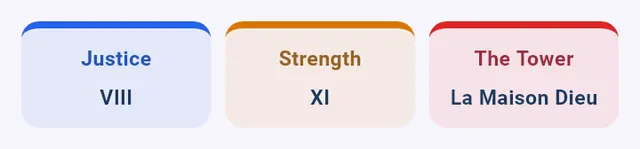
- Justice (VIII) and Strength (XI): These are reversed compared to RWS (Waite swapped them to align with astrological attributions)
- The Hanged Man: Often called "The Hanging Man"—some see a figure suspended by choice, others see punishment
- Death: Depicts a skeleton with a scythe mowing down figures—stark and unambiguous
- The Tower: Called "The House of God" (La Maison Dieu)—lightning strikes a tower, figures fall
The simplicity forces you to engage with the archetype directly, without intermediary narrative.
4. Non-Scenic Court Cards
Court cards (Page, Knight, Queen, King) show single figures holding their suit symbol. Like the Majors, they're iconic and static—not engaged in narrative scenes. Interpreting them requires understanding rank, suit, elemental dignity, and archetypal role.
Reading with the Marseille Tradition
Reading TdM requires a different skill set than RWS:
1. Numerology and Elemental Theory
Without illustrated scenes, you engage deeply with:
- Numerology: What does "3" mean? What about "8"? Each number has spiritual, psychological, and practical meanings.
- Elements: How do Fire (Batons), Water (Cups), Air (Swords), and Earth (Coins) interact? What happens when emotions (Cups) meet action (Batons)?
2. Color Reading
Pay attention to which colors appear in a spread. A reading dominated by red might indicate action, physicality, urgency. Heavy blue suggests contemplation, spirituality, or detachment.
3. Pattern Recognition
The geometric patterns formed by suit symbols can be "read" intuitively. Are the swords pointing up (aggression, ambition) or down (defensiveness, retreat)? Are the cups open (receptive) or closed?
4. Direct Intuition
Without predefined narratives, your intuition must engage directly with the card. What do YOU see? What feelings arise? The TdM rewards those who trust their inner sight rather than memorized meanings.
Philosophical Differences from RWS
The Marseille tradition embodies different tarot philosophy:
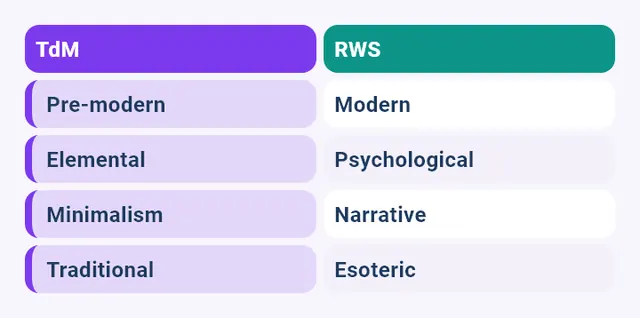
- Pre-modern vs. Modern: TdM is rooted in Renaissance and medieval symbolism; RWS reflects early 20th-century occultism and psychology
- Elemental vs. Psychological: TdM emphasizes elemental energies and natural philosophy; RWS focuses on psychological narratives and Jungian archetypes
- Minimalism vs. Narrative: TdM trusts the reader's intuition with minimal imagery; RWS guides the reader with detailed scenes
- Traditional vs. Esoteric: TdM predates Golden Dawn modifications; RWS is built on esoteric overlays
Neither is "better"—they're different lenses on the same archetypal wisdom.
Modern Marseille Practice
Today's Marseille readers include:
- Traditionalists: Those who value historical continuity and pre-modern symbolism
- Intuitive Readers: Those who prefer open-ended imagery and direct engagement
- Elemental Practitioners: Those focused on elemental magic, alchemy, and natural philosophy
- European Cartomancers: Especially in France, Switzerland, and Italy, where TdM remains the traditional deck
Contemporary Marseille decks include restored historical versions (Conver, Dodal, Noblet) and modern interpretations (CBD Marseille, Tarot de Marseille by Jodorowsky/Camoin).
Strengths of the Marseille Tradition
- Historical authenticity: The oldest continuous tarot lineage
- Elemental clarity: Direct engagement with elemental energies
- Intuitive openness: Minimal imagery invites personal interpretation
- Numerological depth: Encourages study of sacred numbers
- Visual elegance: Bold, timeless design aesthetic
- Cultural heritage: Connects to European cartomantic traditions
Challenges for Modern Readers
- Learning curve: Requires numerology and elemental theory knowledge
- Fewer resources: Not as many books as for RWS
- Less accessible: Unillustrated Minors can feel opaque to beginners
- Cultural distance: Medieval Christian imagery may feel foreign
- Different card order: Justice/Strength swap can confuse RWS-trained readers
Conclusion
The Tarot de Marseille is tarot in its oldest, most essential form. It asks you to engage with pure symbol, color, number, and element—to see beyond narrative and touch the archetypal directly. For readers seeking historical grounding, elemental magic, or intuitive freedom, the Marseille tradition offers profound rewards.
Learning TdM doesn't mean abandoning RWS—it means expanding your tarot vocabulary. Many readers work with both traditions, appreciating what each offers. The Marseille deck reminds us that tarot was never meant to be easy or obvious. It's meant to challenge us, to invite us deeper into mystery, to trust our inner knowing.
In the words of the Marseille masters: the cards don't tell you what to see. They reveal what you already know.
Key Points
- Oldest continuous tarot tradition, standardized in 17th-18th century France
- Used for gaming for 200+ years before divination practices emerged
- Unillustrated Minor Arcana: geometric patterns of suit symbols only
- Bold primary colors (red, blue, yellow) as symbolic interpretive keys
- Archetypal simplicity in Major Arcana without narrative detail
- Requires numerology, elemental theory, and direct intuition to read
- Justice (VIII) and Strength (XI) positions differ from RWS
- Represents pre-modern, pre-esoteric tarot before Golden Dawn influences
- Strengths: historical authenticity, elemental clarity, intuitive openness
- Challenges: learning curve, fewer resources, less accessible to beginners
Traditional Sources
- Dummett, Michael. "The Game of Tarot" (1980) - Marseille history and gameplay
- Jodorowsky, Alejandro & Costa, Marianne. "The Way of Tarot" (2004) - Modern Marseille interpretation
- Place, Robert M. "The Tarot: History, Symbolism, and Divination" (2005) - Historical context
- Depaulis, Thierry. "Tarot, Jeu et Magie" (1984) - French cartomantic traditions
- Flornoy, Jean-Claude. Multiple restored historical decks (Noblet, Dodal, Conver)
Further Reading
- Study numerology basics: what do numbers 1-10 represent spiritually and psychologically?
- Practice reading Marseille Minor Arcana without consulting meanings—trust your eyes
- Compare a Marseille card to its RWS equivalent—what feels different?
- Explore historical Marseille decks (Conver, Dodal, Noblet) to see variations