
On this page
- Introduction
- What Makes a Deck "Tarot"?
- What Are Oracle Cards?
- The Historical Difference
- When to Use Tarot
- When to Use Oracle Cards
- Can You Mix Tarot and Oracle Cards?
- Recognizing "Fake Tarot"
- Choosing the Right Tool for You
- Neither Is "Better"
- Starting Your Journey
- Conclusion
- Key Points
- Traditional Sources
- Further Reading
Introduction
One of the most common questions beginners ask is: "What's the difference between tarot cards and oracle cards? Which should I use?" The answer reveals an important truth about divination tools—structure matters, but so does personal connection.
Understanding the distinction between tarot and oracle decks helps you choose the right tool for your practice, recognize what you're working with, and navigate the often-confusing landscape of card-based divination. Both are valid. Both are powerful. But they work differently.
What Makes a Deck "Tarot"?
Tarot has a specific, traditional structure that defines it:
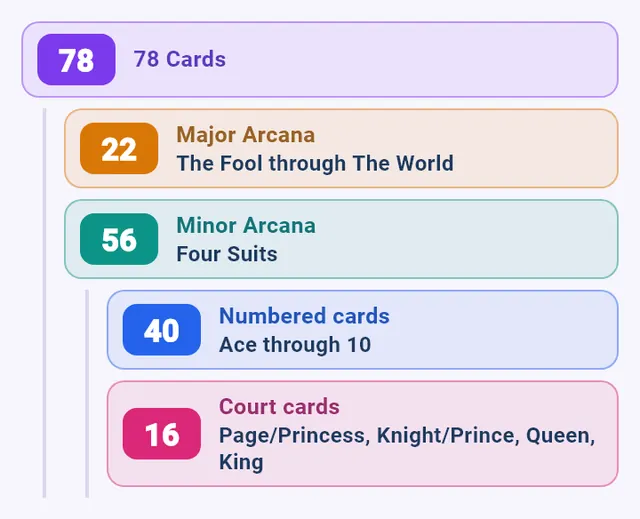
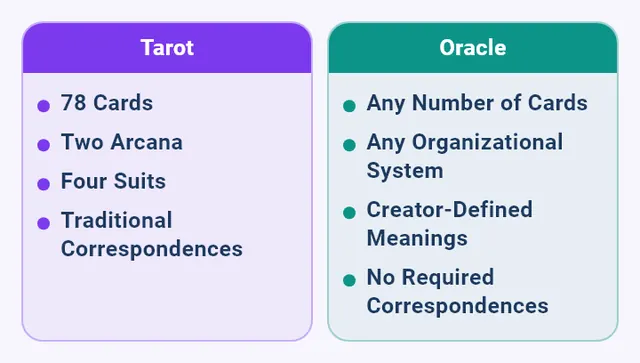
78 Cards: A tarot deck must have 78 cards (with rare historical exceptions). Not 77, not 80. Exactly 78.
Two Arcana:
- Major Arcana: 22 cards representing major life themes and archetypal journeys (The Fool through The World)
- Minor Arcana: 56 cards representing everyday experiences and situations
Four Suits: The Minor Arcana divides into four suits, each with:
- Numbered cards: Ace through 10 (40 cards total)
- Court cards: Page/Princess, Knight/Prince, Queen, King (16 cards total)
Traditional Correspondences: Most tarot decks maintain connections to:
- Elements (Fire, Water, Air, Earth)
- Astrology (zodiac signs, planets, decans)
- Kabbalah (Tree of Life paths, though this varies)
- Numerology (the significance of numbers 1-10)
Consistent Archetypal Framework: While artistic styles vary wildly, the archetypal journey remains recognizable. The Fool's journey from card 0 to 21 follows a similar path across most decks. The suit progressions (Ace to 10) tell similar stories.
Even radically reimagined tarot decks (like the Wild Unknown Tarot or the Modern Witch Tarot) maintain this 78-card structure and archetypal framework. You can swap out medieval European imagery for animals, modern witches, or abstract art, but if it's tarot, it has 78 cards and maintains the Major/Minor Arcana division.
What Are Oracle Cards?
Oracle decks have no fixed structure. They can be:
Any Number of Cards: Oracle decks range from 30 cards to 100+ cards. There's no standard. The creator decides.
Any Organizational System: Some oracle decks organize by themes (chakras, angels, goddesses, moon phases, crystals, affirmations). Others have no organizational system at all—just a collection of messages or images.
Creator-Defined Meanings: While tarot has centuries of accumulated tradition and symbolism, oracle card meanings are defined by their creator. The "Harmony" card means what the deck's creator says it means, not what centuries of tarot tradition dictate.
Thematic Focus: Most oracle decks center on a specific theme:
- Angel Cards: Connecting with angelic guidance
- Goddess Cards: Working with divine feminine archetypes
- Affirmation Cards: Positive messages for daily guidance
- Animal Spirit Cards: Totem and power animal wisdom
- Moon Phase Cards: Lunar cycle guidance
- Crystal Cards: Crystal healing and energy work
Simplified or Poetic Messages: Many oracle decks feature short affirmations, questions, or poetic messages rather than complex symbolic images. They're designed to be immediately accessible without study.
No Required Correspondences: Oracle decks don't need to connect to astrology, elements, Kabbalah, or numerology unless the creator chooses to include those systems.
The Historical Difference
Tarot emerged in 15th-century Italy as playing cards, then evolved through centuries of occult study and symbolic development. It has a documented history, scholarly research, and accumulated tradition. When you read tarot, you're working with a system refined over 600 years.
Oracle cards are a modern invention, mostly emerging in the late 20th and early 21st centuries. While divination using various symbols (runes, bones, shells, etc.) is ancient, the specific format of "oracle card decks" is contemporary. There's no ancient oracle card tradition to study—modern creators invent their own systems.
This doesn't make oracle cards less legitimate. It means they're freer, more experimental, and less bound by tradition.
When to Use Tarot
Choose tarot when you want:
Structured Framework: The 78-card system provides comprehensive coverage of human experience. Major Arcana for big life themes, Minor Arcana for daily situations, four suits for different life areas (creativity, emotions, intellect, material world).
Depth and Complexity: Tarot rewards study. You can spend years exploring symbolism, correspondences, and layered meanings. Every time you return to a card, you discover something new.
Traditional Esoteric Connections: If you're interested in Kabbalah, astrology, alchemy, or ceremonial magic, tarot integrates these systems beautifully.
Detailed Readings: The 78-card structure allows for nuanced, multi-card spreads that explore complex questions from many angles.
Learning an Established System: Tarot has countless books, teachers, courses, and communities. You're never alone in learning it.
Shadow Work and Challenge: Tarot doesn't shy away from difficult truths. Cards like The Tower, Death, and the Five of Pentacles confront you with hard realities. This can be exactly what you need.
When to Use Oracle Cards
Choose oracle cards when you want:
Simplicity and Accessibility: Oracle decks are often easier for beginners. Pull a card, read the message, done. No need to memorize 78 meanings.
Affirmation and Encouragement: Many oracle decks focus on positive, uplifting messages perfect for daily inspiration or building confidence.
Specific Themes: If you're working specifically with angels, goddesses, moon phases, chakras, or animals, a themed oracle deck provides focused guidance.
Flexibility: You can create your own oracle deck or modify interpretations freely. There's no "wrong" way because there's no established tradition to violate.
Quick Guidance: Oracle cards excel at one-card daily draws for simple, direct guidance without complex interpretation.
Gentle Introduction: If tarot feels intimidating or overwhelming, oracle cards offer a softer entry point to divination practice.
Can You Mix Tarot and Oracle Cards?
Absolutely! Many readers use both:
Tarot for Structure, Oracle for Themes: Pull a tarot spread for the framework of a reading, then add an oracle card for specific themed guidance (like an angel card for spiritual support or a goddess card for feminine energy).
Oracle for Clarification: When a tarot card's meaning feels unclear, pull an oracle card to clarify or add context.
Oracle for Affirmation: After a challenging tarot reading, pull an oracle card for encouragement or action steps.
Separate Practices: Use tarot for deep monthly readings and oracle cards for quick daily guidance.
Mixed Spreads: Some readers design spreads intentionally mixing both. For example, Celtic Cross with tarot cards, then an oracle card in the center for the "heart message."
There's no rule against mixing—only your personal practice and what feels right to you.
Recognizing "Fake Tarot"
Sometimes decks market themselves as "tarot" but aren't structurally tarot:
Wrong Card Count: If it has 40 cards or 50 cards, it's not tarot, no matter what the packaging says. It's an oracle deck with tarot theming.
No Major/Minor Arcana Division: True tarot has 22 Major Arcana and 56 Minor Arcana. If the deck doesn't maintain this division, it's not structurally tarot.
Different Suit Structure: If the suits don't have Ace-10 plus four court cards each, it's not following tarot structure.
This doesn't make these decks bad—many are beautiful and powerful. But calling them "tarot" is marketing, not accuracy. They're tarot-inspired oracle decks.
Choosing the Right Tool for You
Ask yourself:
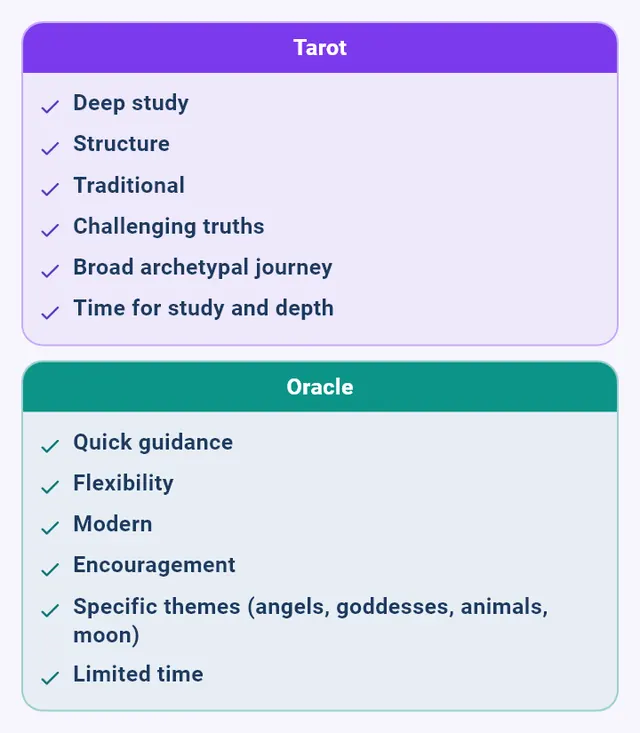
Do you want deep study or quick guidance? Deep study → Tarot. Quick guidance → Oracle.
Do you prefer structure or flexibility? Structure → Tarot. Flexibility → Oracle.
Are you drawn to traditional systems or modern creativity? Traditional → Tarot. Modern → Oracle.
Do you want challenging truths or encouraging affirmations? Challenging truths → Tarot. Encouragement → Oracle (though many oracle decks can be challenging too).
What themes interest you? Broad archetypal journey → Tarot. Specific themes (angels, goddesses, animals, moon) → Oracle.
How much time do you have? Limited time → Oracle. Time for study and depth → Tarot.
You can also choose both. Many practitioners own multiple tarot decks and multiple oracle decks, using each for different purposes.
Neither Is "Better"
The tarot community sometimes displays snobbery toward oracle cards, treating them as "tarot lite" or inferior. This is unfair and inaccurate.
Oracle cards are a different tool with different strengths. A hammer isn't "better" than a screwdriver—they serve different purposes. Similarly, tarot and oracle cards serve different divination needs.
Tarot's strength is its comprehensive archetypal structure and centuries of accumulated wisdom. Oracle's strength is thematic focus, flexibility, and accessibility.
Use the tool that serves your practice. If someone judges you for using oracle cards instead of tarot (or vice versa), that's their limitation, not yours.
Starting Your Journey
If you're new to divination:
Start with Whatever Calls to You: If a tarot deck's artwork speaks to your soul, start there. If an oracle deck's theme fascinates you, start there. Attraction and connection matter more than arbitrary rules.
Don't Overthink It: You can always add the other type later. Starting with tarot doesn't mean you can never use oracle cards. Starting with oracle cards doesn't mean you're not a "real" reader.
Collect What Resonates: Over time, most practitioners accumulate both tarot and oracle decks. There's no limit—follow your interests.
Learn the Basics: If you choose tarot, learn the 78-card structure and basic meanings. If you choose oracle, read the guidebook to understand the creator's intended meanings.
Practice, Practice, Practice: Both tarot and oracle cards improve with use. Daily draws, journaling, and regular readings build skill and intuition.
Conclusion
Tarot and oracle cards are both powerful divination tools, but they work differently. Tarot provides structured, comprehensive archetypal wisdom refined over centuries. Oracle cards offer flexible, thematic, accessible guidance created by modern visionaries.
You don't have to choose one forever. You can use both, switch between them, or blend them. The only requirement is that you use them with intention, respect, and an open heart.
Tarot is not "better" than oracle cards. Oracle cards are not "easier" than tarot. They are different tools for different purposes, different moods, different questions.
Choose the tool that serves your spiritual path, supports your practice, and speaks to your intuition. And remember: the magic isn't in the cards themselves—it's in the wisdom, insight, and self-reflection they help you access.
Key Points
- Tarot has fixed structure: 78 cards, 22 Major Arcana, 56 Minor Arcana (4 suits of Ace-10 + 4 court cards)
- Oracle cards have no fixed structure: any number of cards, any organization, creator-defined meanings
- Tarot: 600+ years of tradition, esoteric correspondences, comprehensive archetypal framework
- Oracle: Modern invention, thematic focus (angels, goddesses, affirmations, animals), simplified messages
- Use tarot for: depth, study, structure, traditional systems, detailed readings, shadow work
- Use oracle for: simplicity, affirmations, specific themes, flexibility, quick guidance, gentle introduction
- You can mix both: tarot for structure + oracle for themes, oracle for clarification, separate or blended practices
- "Fake tarot" marketed decks may lack 78-card structure or Major/Minor division—they're oracle decks with tarot themes
- Neither is "better"—they're different tools for different purposes, moods, and questions
- Choose based on: personal preference, time available, desired depth, themes of interest, spiritual path
Traditional Sources
- Pollack, Rachel. "Tarot Wisdom" (2008) - Discusses both tarot and oracle approaches
- Fairchild, Alana. "Kuan Yin Oracle" (2013) - Example of modern oracle creation
- Virtue, Doreen. "Angel Tarot Cards" (2012) - Blends tarot structure with oracle themes
- Place, Robert M. "The Tarot: History, Symbolism, and Divination" (2005) - Tarot structure
- Modern Oracle Creators: Explore diverse contemporary decks to understand oracle flexibility
Further Reading
- Try both: Get a beginner tarot deck (RWS-based) and a simple oracle deck to experience both
- Explore oracle themes: Find oracle decks matching your interests (angels, animals, goddesses, affirmations)
- Read guidebooks: Oracle guidebooks explain creator intentions; tarot guidebooks teach traditional meanings
- Trust your intuition: Choose decks that visually and energetically resonate with you, regardless of type