
On this page
Introduction
Sacred space isn't about religion or elaborate altars (though it can include those). It's about creating a container—physical, energetic, and psychological—where you can:
- Shift from everyday mind to intuitive awareness
- Signal to yourself (and the cards): "I'm ready to listen"
- Reduce distractions so you can focus deeply
- Honor the practice as meaningful, not casual
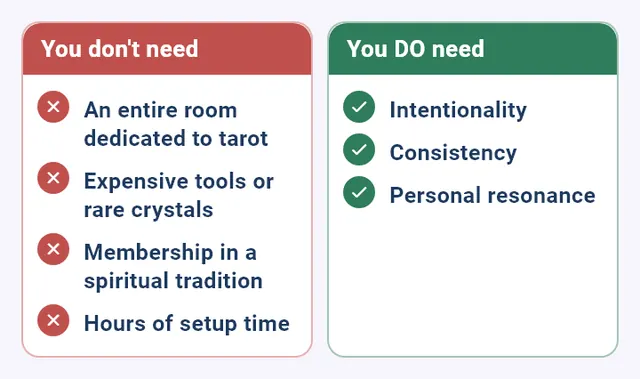
You don't need:
- ❌ An entire room dedicated to tarot
- ❌ Expensive tools or rare crystals
- ❌ Membership in a spiritual tradition
- ❌ Hours of setup time
You DO need:
- ✅ Intentionality (even 30 seconds of conscious transition)
- ✅ Consistency (ritual trains your mind to drop into reading mode)
- ✅ Personal resonance (what feels sacred to YOU, not Instagram tarot aesthetics)
This lesson teaches you how to create sacred space that serves your practice, whether you're reading in your bedroom, a coffee shop, or a professional reading room.
Why Sacred Space Matters
1. Psychological Boundary
Sacred space creates a threshold: you cross from "regular life" into "reading space."
Without this boundary:
- You're half in the reading, half thinking about dinner/work/texts.
- Cards feel like a random game, not a meaningful practice.
- Distractions dilute your focus.
With this boundary:
- Your mind shifts gears: "I'm in reading mode now."
- Intuition flows more easily.
- The reading feels distinct from scrolling or daydreaming.
Example: Lighting a candle becomes a ritual cue—your subconscious learns: "Candle lit = time to tune in."
2. Energetic Clarity
Physical spaces hold energy. Your reading space might carry:
- Residual stress (if you read where you also work/argue/doom-scroll)
- Other people's energy (if reading in shared/public spaces)
- Stagnant energy (if the space is rarely used or cleaned)
Creating sacred space clears and resets the energetic field so your reading isn't clouded by ambient noise.
Think of it like: Cleaning a window before looking through it. You CAN read through a dirty window—but clarity improves when you wipe it clean.
3. Honoring the Practice
Tarot isn't party trick or idle entertainment. It's a tool for wisdom, reflection, and growth.
Creating sacred space says:
- "This matters to me."
- "I'm treating this with respect."
- "I'm showing up intentionally."
Paradox: The more you honor the practice, the more potent your readings become. Ritual isn't superstition—it's embodied intention.
Elements of Sacred Space
You don't need ALL of these. Choose what resonates.
1. Physical Cleanliness
Why: Clutter = mental clutter. A clean space helps you focus.
Practice:
- Clear surface of random objects (old mail, dishes, etc.).
- Wipe down the reading surface (even just with your hand).
- Arrange your deck, cloth, and any tools neatly.
Time: 1-2 minutes.
This signals: "I'm creating order. I'm ready."
2. Designated Reading Cloth or Mat
Why: Creates visual boundary between "reading space" and "regular surface."
Options:
- Tarot cloth (purchased or DIY)
- Scarf, bandana, or piece of fabric you designate for readings
- Wooden board or tray (portable reading surface)
Pro tip: Use the same cloth every time. Your mind will associate it with reading mode.
3. Lighting
Why: Shifts atmosphere from "everyday" to "intentional."
Options:
- Candle (classic, ritual-invoking)
- Dim overhead lights / use lamp (softer than bright fluorescents)
- Salt lamp, string lights (ambient glow)
- Natural light (reading by window during golden hour)
Caution: Too dim = can't see cards clearly. Balance ambiance with visibility.
4. Scent
Why: Smell is most primal sense—directly linked to memory and emotion. Scent anchors you into reading space fast.
Options:
- Incense (stick or cone: sandalwood, frankincense, dragon's blood)
- Essential oils (diffuser or dab on wrists: lavender, rosemary, cedar)
- Palo santo or sage (energetic clearing + scent)
- Fresh flowers or herbs (rosemary, lavender sprigs)
Practice: Use the same scent every time you read. Your brain will Pavlov into intuitive mode when you smell it.
5. Sound
Why: Sound masks distractions and creates auditory container.
Options:
- Silence (if you read best in quiet)
- Instrumental music (ambient, lo-fi, tarot playlists on Spotify)
- Singing bowl or bell (sound to "open" the reading)
- Binaural beats (theta waves for intuition)
- Nature sounds (rain, forest, ocean)
Avoid: Lyrics (they engage verbal mind, which competes with intuition).
6. Grounding and Centering
Why: Before reading, you need to drop out of monkey-mind into present awareness.
Practice (2-3 minutes):
- Sit comfortably. Close eyes (or soft gaze).
- Three deep breaths: Inhale for 4, hold for 4, exhale for 6.
- Body scan: Notice where you're holding tension. Soften.
- Visualize roots growing from your tailbone/feet into earth. Feel grounded.
- Set intention: "I am present. I am open. I listen with clarity."
Result: You're no longer scattered. You're here.
7. Energetic Clearing
Why: Clear residual energy from previous readings, your day, or the space itself.
Options:
- Smoke cleansing: Sage, palo santo, rosemary, or incense. Pass smoke over deck, self, and space.
- Sound: Ring bell, clap hands sharply, use singing bowl.
- Visualization: Imagine bright light flooding the space, dissolving any stagnant energy.
- Selenite or clear quartz: Place on/near deck to "reset" energy.
Frequency: Clear space before readings. Clear deck after heavy/emotionally intense readings.
8. Setting Intention
Why: Sacred space isn't passive—it's activated by intention.
Practice (spoken aloud or silently):
- "I create this space for clarity, truth, and guidance."
- "This is a container for wisdom. I am here to listen."
- "I honor the cards, my intuition, and the querent's journey."
Why it works: Intention focuses your energy. You're not just shuffling cards—you're opening a channel.
Sacred Space in Different Settings
At Home: Dedicated Reading Corner
Best for: Regular practice, privacy, consistency.
Setup:
- Small table or shelf
- Tarot cloth, candle, incense holder
- Deck stored nearby (in box or wrapped in silk)
- Optional: crystals, oracle deck, journal
Ritual: Enter this corner ONLY for tarot. Train your mind: "This corner = sacred work."
At Home: Impromptu Reading (Bed, Floor, Desk)
Best for: Spontaneous draws, casual readings, small spaces.
Setup:
- Lay down cloth (even a scarf)
- Light candle OR play instrumental music
- 1-minute grounding breath
- Clear clutter from immediate area
Key: Consistency of ritual matters more than perfection of space. Same cloth + same breath + same intention = sacred space, even on your bedroom floor.
Public/Shared Spaces (Coffee Shop, Park, Friend's House)
Best for: Reading for others, flexibility, practicing "portable sacred space."
Setup:
- Bring small travel cloth (bandana-sized)
- Ground yourself with 3 deep breaths (no tools needed)
- Mental boundary: Visualize bubble of light around you and querent—inside is sacred, outside is noise
- Optional: Small selenite or clear quartz in pocket
Key: Sacred space is mostly internal. Physical tools help, but YOUR FOCUS creates the container.
Professional Reading Space
Best for: Paid clients, building reputation, serious practice.
Setup:
- Clean, organized table (no clutter visible)
- Consistent aesthetic (your "brand" as reader)
- Tarot cloth, candle (unscented if clients have sensitivities)
- Crystals, plants, or meaningful objects (but not overwhelming)
- Comfortable seating for client
Pre-client ritual: Before client arrives, clear space (smoke/sound), ground yourself, set intention for their highest good.
Creating Sacred Space: Step-by-Step
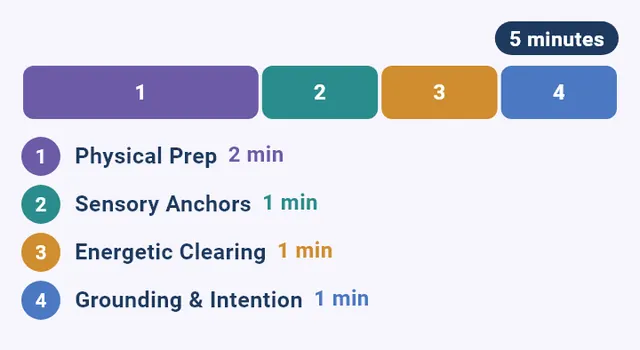
For a typical at-home reading (5 minutes):
Step 1: Physical Prep (2 min)
- Clear surface
- Lay cloth
- Place deck and any tools (journal, crystals)
Step 2: Sensory Anchors (1 min)
- Light candle
- Light incense OR dab essential oil
- Start instrumental music (optional)
Step 3: Energetic Clearing (1 min)
- Pass smoke over space and deck (OR ring bell, clap, visualize light)
Step 4: Grounding & Intention (1 min)
- Sit. Close eyes.
- Three deep breaths.
- Set intention: "I create sacred space for truth and clarity. I am present."
Step 5: Begin Reading
- You're in sacred space now. Read.
Step 6: Closing (after reading)
- Thank the cards (spoken or silent)
- Extinguish candle
- Store deck respectfully
- Energetic clearing if needed (especially after intense readings)
Common Mistakes
1. Over-complicating It
Mistake: Thinking you need 20 crystals, a full altar, rare incense, perfect silence, moon water, etc.
Truth: Sacred space can be 30 seconds of intentional breath + laying down a scarf. Ritual serves YOU—don't let it become stressful.
2. Performing for Aesthetics, Not Function
Mistake: Creating "Instagram-worthy" altar that doesn't actually help you read better.
Truth: Sacred space is functional, not performative. If your elaborate setup stresses you out or feels fake, simplify.
3. Skipping It Entirely
Mistake: "I don't have time for ritual. I'll just shuffle and pull."
Result: Readings feel scattered, surface-level, or disconnected.
Truth: Even 30 seconds of grounding makes HUGE difference. Sacred space isn't extra—it's foundation.
4. Rigidity
Mistake: "If I can't do my full 10-minute ritual, I won't read at all."
Truth: Adapt. If you only have 1 minute, do 1-minute version (breathe, set intention). Sacred space is scalable.
Sacred Space for Different Reading Types
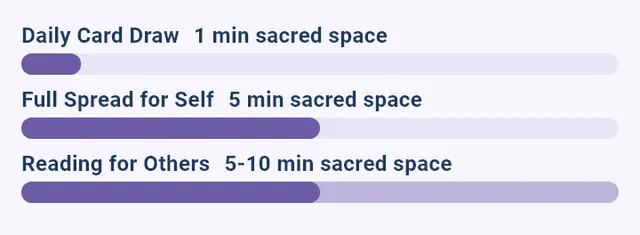
Daily Card Draw (1 min sacred space)
- Light candle
- One deep breath
- Set intention: "What do I need to know today?"
- Draw
Full Spread for Self (5 min sacred space)
- Full setup: cloth, candle, incense, music
- Grounding + clearing
- Set intention for specific question
Reading for Others (5-10 min sacred space)
- Full setup
- Pre-client grounding and clearing
- Intention: "I serve [client's name]'s highest good."
- After reading: Clear space and self
Personalizing Your Sacred Space
Your sacred space should reflect YOUR practice—not someone else's.
Questions to explore:
- What makes me feel grounded and focused?
- What scents/sounds help me drop into intuition?
- Do I prefer minimal or abundant aesthetics?
- Do I need silence or ambient sound?
- Do I read better in morning (natural light) or evening (candlelight)?
Experiment: Try different setups for a week each. Notice what actually HELPS vs. what just looks nice.
Conclusion
Sacred space isn't about rules or aesthetics. It's about creating a threshold—a clear boundary between everyday mind and intuitive awareness.
You need less than you think:
- Intentional breath
- Clear surface
- Designated cloth
- One ritual anchor (candle, scent, sound)
The magic isn't in the tools—it's in YOUR FOCUS.
When you consistently create sacred space (even the 30-second version), you:
- Train your mind to drop into reading mode fast
- Honor the practice as meaningful
- Create energetic clarity for better readings
- Show up with intention, not distraction
Your practice this week:
- Choose 3-5 elements from this lesson that resonate (e.g., cloth, candle, grounding breath, intention).
- Create sacred space before every reading this week (even daily card draws).
- Journal: Did readings feel different? Did you focus better? What elements actually helped?
The cards are ready. The space is sacred. Now you show up. 🕯️✨
Key Points
- Sacred space creates psychological boundary: threshold from everyday mind to intuitive awareness
- Clears energetic field so readings aren't clouded by residual stress, other people's energy, or stagnation
- Honoring practice with ritual increases reading potency—embodied intention, not superstition
- Minimal requirements: intentional breath, clear surface, designated cloth, one ritual anchor (candle/scent/sound)
- Physical cleanliness reduces mental clutter; clean surface helps focus
- Reading cloth creates visual boundary; use same one consistently to train mind
- Lighting shifts atmosphere (candle, dim lamp, natural light) but balance ambiance with visibility
- Scent anchors you fast (incense, oils, palo santo); use same scent every time to Pavlov into reading mode
- Sound masks distractions (instrumental music, silence, singing bowl); avoid lyrics that engage verbal mind
- Grounding practice (3 deep breaths, body scan, visualize roots, set intention) shifts from scattered to present
- Energetic clearing removes residual energy (smoke, sound, visualization, selenite/quartz)
- Setting intention activates space—not passive setup but conscious channel opening
- Sacred space adapts: dedicated corner at home, impromptu setup on floor, portable cloth in public, professional client space
- Common mistakes: over-complicating, performing for aesthetics, skipping entirely, rigid inflexibility
- Sacred space is mostly internal—physical tools help, but YOUR FOCUS creates container
Traditional Sources
- Sacred space concept crosses traditions: altars in Wicca, shrines in Buddhism, prayer corners in Islam, meditation spaces
- Tarot-specific: Golden Dawn practitioners created elaborate temple spaces; modern readers adapt to any environment
- Sensory anchoring (scent, sound, light) rooted in neuroscience: consistent cues train brain to enter specific states
- Energy clearing practices: adapted from smudging (Indigenous traditions—use with cultural respect), Reiki, feng shui
- Threshold rituals: lighting candles, ringing bells, setting intentions found across spiritual traditions as state-shift markers
Further Reading
- Benebell Wen: "Holistic Tarot" (Ch. 21: The Setting of a Tarot Reading and Energetic Supplements)
- Mary K. Greer: "21 Ways to Read a Tarot Card" (ritual practices)
- Rachel Pollack: "The New Tarot Handbook" (creating sacred reading environment)
- Online: Search "tarot sacred space setup" for visual inspiration (but remember: function > aesthetics)