
On this page
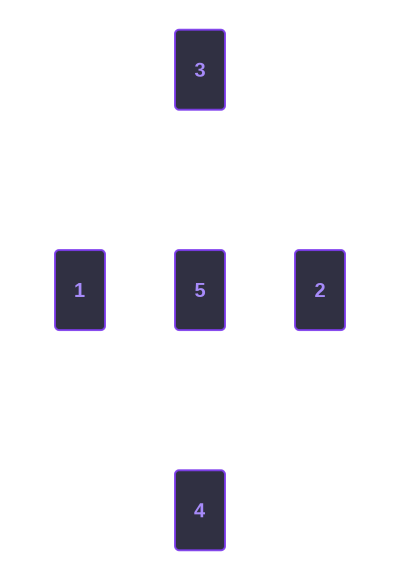
- In Favour
- Against
- The Judge
- The Sentence
- The Synthesis
Purpose of this Spread
Wirth's cross treats a question as a trial. Two cards plead, one for and one against; a third judges between them; a fourth pronounces the sentence; and a fifth, in the centre, gathers everything into one idea. It is the classic spread of the French school, where it is known as the cross draw (tirage en croix).
When to Use
Use it for one precise question about a decision, a plan or a conflict, ideally one you can state in a single sentence. It responds well to questions of the kind: what happens if I do this?
When to Avoid
It is not meant for a general overview of your life or for following a long process over time; it judges one case. Avoid asking the same question twice in a row because you disliked the sentence.
How to Read
The cards are laid in this order: In Favour on the left, Against on the right, The Judge above, The Sentence below and The Synthesis in the centre. Wirth read the centre first, because it says what the whole matter is about, and then heard the case: the plea in favour, the plea against, the judge's advice and the sentence. Read the two side cards as a pair, never alone. A harsh card In Favour is still an ally: it shows a hard thing that helps.
History & Tradition
Published by the Swiss occultist Oswald Wirth (1860–1943) in Le Tarot des imagiers du Moyen Âge (Paris, 1927); he said he had learnt it from Stanislas de Guaita and Joséphin Péladan. In the original only the 22 Major Arcana are used, and the fifth card is not drawn: it is found by adding the numbers of the other four. Here the five cards are drawn from the full deck, a common modern simplification; the positions keep Wirth's meaning.
Card Relationships
- In Favour and Against are the two pleas of the trial
- The Judge gives the advice and The Sentence shows what follows from it
Similar Spreads
If you like this, try these