
On this page
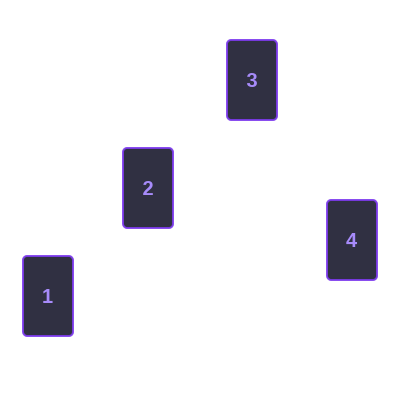
- The Setting
- The Plot
- The Turning Point
- The Ending
Purpose of this Spread
Many dreams are built like a short play. This spread lays one card on each of its four parts, so you can see where the story starts, where it tightens, where it turns and how it ends. It is the right spread for long, narrative dreams with a clear sequence of scenes.
When to Use
Use it when you can tell the dream as a story with a beginning and an end. It is especially useful when the dream stopped abruptly or you woke before the ending: the fourth card then speaks about what was left open.
When to Avoid
It does not fit dreams that are a single image or a bare feeling with no story; for those, use Dream Message. Do not force four acts onto a dream that does not have them.
How to Read
Divide your dream into four parts before you look at the cards. Then read from left to right, following the line as it climbs to The Turning Point and comes down to The Ending. Notice which act the card fits best and which one it contradicts: the contradiction is usually where the reading has something to say. If your dream had no ending, read The Ending as the question the dream leaves with you.
History & Tradition
The four parts come from Carl Gustav Jung. In his essay On the Nature of Dreams (1945) he observed that many dreams have a structure not unlike that of a drama, and named its phases exposition, development, culmination or peripeteia, and lysis, with terms taken from the theatre. Jung was describing dreams, not a card layout: turning his four phases into a tarot spread is our own adaptation.
Card Relationships
- The Setting and The Ending show how far the dream travels from its starting point
- The Plot and The Turning Point show what builds the tension and what breaks it
Similar Spreads
If you like this, try these
Dream Message · 4 Cards · Beginner