
On this page
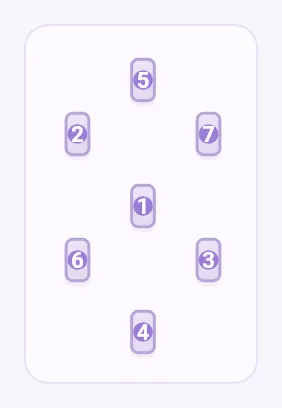
- The Relationship
- You
- Partner
- Your Desires
- Their Desires
- What You Give
- What They Give
Purpose of this Spread
The Relationship Spread is a seven-card mirror of the dance between two people. It honors each person's own position while illuminating the bond they create together—the relationship at the center, what each of you desires from it, and what each of you is truly willing to give. This spread doesn't predict 'will we stay together?' but offers insight into 'who are we together, what does each of us want, and does what we give meet what the other needs?'
When to Use
Draw the Relationship Spread when you need to understand the deeper dynamics of a significant connection—romantic partnership, close friendship, family bond, or even a complex work relationship. Perfect when communication has broken down and you need perspective on what the other person might be experiencing. Use this spread when you're contemplating the relationship's health, when conflicts keep arising without resolution, when you sense a shift in the dynamic but can't name it, or when you need clarity on whether your needs and theirs can coexist. Especially powerful when both people are willing to hear truths about themselves and each other. This spread works for established relationships with history—it has less to offer for brand-new connections that haven't yet developed complexity.
When to Avoid
Avoid this spread for 'will they come back?' or 'do they love me?' questions—those are predictive, not exploratory. Skip it if you're not ready to see your own role in the relationship's challenges (the 'You' card can be confronting). Don't use this for casual dating or crushes where there's no established dynamic yet. Also inappropriate if you're using it to manipulate or control the other person—tarot should empower both parties, not just one.
How to Read
Begin with The Relationship (1), at the center: it shows the bond as an entity of its own, beyond the two individuals. If it's harmonious, the relationship is healthy even if each person is struggling; if it's fractured, even compatible people are hurting each other. Then read You (2) and Partner (3) as portraits—what energy does each person bring right now? Notice if one is Major Arcana and the other Minor (an imbalance of weight or power). Next, compare Your Desires (4) and Their Desires (5): what each of you wants from this bond. Compatible desires (both Cups for intimacy, both Pentacles for security) give common ground; opposed ones (you want freedom, Wands; they want commitment, Pentacles) call for an honest conversation. Then read What You Give (6) and What They Give (7): the real exchange. The key reading crosses the pairs: does What They Give (7) answer Your Desires (4), and does What You Give (6) answer Their Desires (5)? When what is given meets what is wanted, the bond feeds both; when one side gives what the other doesn't ask for, there is effort without nourishment. Look for Court cards representing real people (ex-partners, family, friends) who may be influencing the dynamic. Reversed cards in the desire positions often show unspoken or suppressed wishes. The absence of a suit across all seven cards can be telling—no Cups = emotional disconnect, no Swords = avoiding difficult truths.
History & Tradition
Relationship spreads evolved in the 19th and early 20th centuries as tarot reading shifted from fortune-telling toward psychological insight and interpersonal understanding. The seven-card relationship layout specifically became popular in the 1970s-80s during the tarot renaissance, when readers began focusing on emotional wellness and self-awareness rather than purely predictive readings. The symmetrical positioning of 'You' and 'Partner' honors the equality of both perspectives—a modern departure from older hierarchical relationship readings.
Card Relationships
- You ↔ Partner: The Individual Portraits
- The Relationship: The Bond as Its Own Entity
- Your Desires ↔ Their Desires: What Each One Wants
- Desire ↔ Gift: Does What One Gives Meet What the Other Wants?
- Full Relationship Ecosystem: All Seven Cards in Dialogue
Similar Spreads
If you like this, try these
Soulmate Search · 7 Cards · Intermediate