
On this page
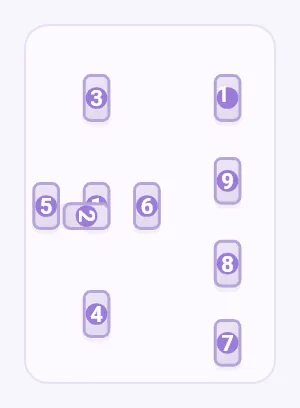
- Present
- Challenge
- Crowns
- Beneath
- Behind
- Near Future
- Self
- Environment
- Hopes & Fears
- Outcome
Purpose of this Spread
The Celtic Cross is the undisputed master of tarot spreads—the most iconic, comprehensive, and deeply layered layout in the entire cartomantic tradition. First codified by Arthur Edward Waite and the Golden Dawn in the early 20th century, this ten-card masterpiece weaves together temporal progression (past-present-future), spatial awareness (internal-external), and psychological depth (conscious-unconscious) into a unified tapestry of insight. It examines not just 'what will happen' but the complete existential landscape: where you've been, where you are, what crosses you, what crowns and grounds you, what lies ahead, how you see yourself, how others see you, what you secretly hope and fear, and ultimately, where all roads lead. This is the spread you turn to when a situation demands the full power of the tarot's wisdom—when nothing less than complete understanding will suffice.
When to Use
Deploy the Celtic Cross for life's most significant questions and complex situations—the kind that keep you awake at night, that have multiple layers, that require seeing the whole chessboard before making your move. Perfect for major life decisions (career changes, relationship commitments, relocations, spiritual awakenings), situations with long histories and uncertain futures, times when you need to understand not just the external facts but your own psychology around the issue. Use this spread when simpler layouts feel insufficient, when you sense there are hidden dimensions you're not seeing, or when you're willing to invest the time and contemplation that ten cards demand. The Celtic Cross excels at revealing the 'why' behind the 'what'—not just predicting outcomes but illuminating the forces, patterns, and choices that create those outcomes. Ideal for quarterly life reviews, before major commitments, during dark nights of the soul, or whenever you need the tarot's full diagnostic and prognostic power. This is advanced work—respect the spread's depth.
When to Avoid
Skip the Celtic Cross for simple questions, daily guidance, or when you want a quick answer—this spread demands time, focus, and interpretive skill. Avoid it if you're a complete beginner (start with Three Card or Five Card Cross first). Don't use it for trivial matters or when you're too emotionally overwhelmed to process ten cards' worth of information. Also inappropriate when you need immediate triage rather than deep analysis, or when the question is narrow and specific (use a targeted spread instead). The Celtic Cross can feel overwhelming if you're not ready for its complexity or if the situation doesn't warrant such thorough examination.
How to Read
Read the Celtic Cross in structural layers, not just linearly. Layer 1: The Cross (positions 1-6) forms the heart. Start with the Present (1) and Challenge (2) together—the Challenge literally crosses the Present, showing what opposes or complicates your current situation. If Challenge is reversed, the obstacle is internal; upright, it's external. Now read the two axes. The vertical one: Crowns (3, above) is your conscious aim, the best you can reach in the matter; Beneath (4, below) is the foundation, what lies at the root and works unseen. The horizontal one traces the timeline: Behind (5, left) → Present (1, center) → Near Future (6, right), from the recent past that is fading to what comes soon. The cross creates a mandala of the situation's core. Layer 2: The Staff (positions 7-10) stands to the right like a pillar, showing the querent's relationship to the situation. Read bottom to top: Self (7) = how you see yourself; Environment (8) = how others/circumstances see you; Hopes & Fears (9) = your secret emotional truth (often paradoxical—you may fear what you hope for); Outcome (10) = where everything leads. The Staff is psychological X-ray. Key Interactions: Present ↔ Challenge (the core conflict), Beneath → Behind → Present (causal chain: root, recent past, now), Crowns ↔ Beneath (conscious aim vs hidden foundation), Crowns ↔ Outcome (alignment check: does what you want match where you're headed?), Self ↔ Environment (internal vs external perception), Hopes & Fears ↔ Outcome (do your fears create the outcome, or do your hopes?). Advanced Reading: Count Major Arcana across all 10 (0-3 = everyday situation, 4-6 = significant life event, 7+ = fated/spiritual crisis). Note dominant suits. Look for 'dialogues' between cards (e.g., if Challenge is Five of Pentacles and Environment is Ten of Cups, others see success while you struggle). The Challenge card is often the key—if you can resolve or accept what crosses you, the path clears. If Crowns and Outcome align, you're on track. If they conflict, course correction is needed. The Celtic Cross should tell one cohesive story when all 10 cards are synthesized—if it feels scattered, look for the hidden thread connecting them.
History & Tradition
The Celtic Cross as we know it was popularized by Arthur Edward Waite in his seminal 1910 book The Pictorial Key to the Tarot, though its exact origins remain debated among occult historians. The Golden Dawn (late 19th century) used a similar 10-card cross layout, and some trace elements back to even older cartomantic traditions. The name 'Celtic' likely references the cross's resemblance to Celtic stone crosses found in Ireland and Scotland, imbuing it with mystical gravitas. What's indisputable is that by the early 20th century, this spread had become the definitive tarot layout—the one taught in every serious occult school, the one professional readers mastered, the one that appeared in countless films and novels as the iconic image of tarot divination. Its endurance stems from its brilliance: the cross structure mirrors both Christian symbolism (accessible to Western audiences) and pre-Christian mandalas (appealing to esotericists), while the 10 positions cover every essential dimension of human experience. It's survived a century because it works—consistently, profoundly, undeniably.
Card Relationships
- Present ↔ Challenge: The Core Conflict - What you face vs what crosses it
- Behind → Present → Near Future: The Temporal Arc
- Crowns ↔ Beneath: Conscious Goals vs Subconscious Foundation
- Present → Near Future: The Immediate Trajectory
- Crowns ↔ Outcome: Aspiration vs Destination
- Self ↔ Environment: Internal vs External Perception
- Hopes & Fears ↔ Outcome: The Psychological Wildcard
- The Complete Cross: 10-Card Symphonic Reading
Similar Spreads
If you like this, try these