
On this page
Introduction
Long before you form a single word about a card, your body has already responded. A tightening in the chest. A softening in the belly. A subtle lean forward or an almost invisible pull back. These are not random sensations—they are your oldest, fastest intuitive language. The body registers meaning faster than the thinking mind can name it, and learning to read those signals turns you from an interpreter of symbols into a living instrument of insight.
Somatic intuition is the practice of treating your body as a reading tool as valid as the cards themselves. Where earlier lessons taught you to trust first impressions and read imagery directly, this lesson asks you to drop beneath the mind entirely and listen to what the body already knows.
Why the Body Speaks First
Your nervous system processes an enormous amount of information outside conscious awareness. Micro-expressions, tone, energetic shifts, and pattern associations are gathered and evaluated in milliseconds. The result surfaces not as a sentence but as a sensation—a gut feeling, a chill, a warmth, a contraction.
The body has no agenda. It does not want the card to mean something flattering or convenient. It reports directly. This makes somatic signals one of the most honest sources of guidance you have, unfiltered by hope, fear, or memorized meaning.
The Three Somatic Channels
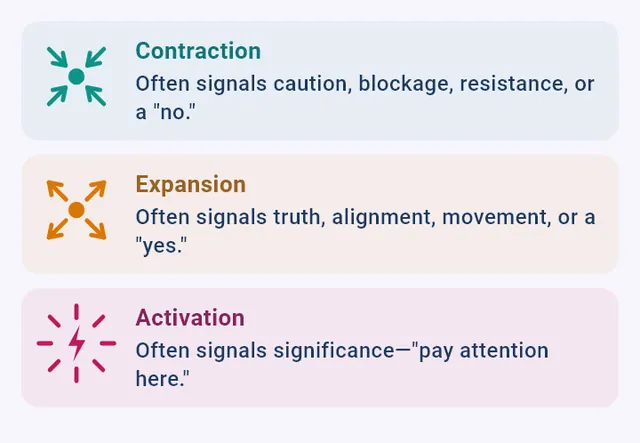
- Contraction: tightening, clenching, holding, coolness, a pulling inward. Often signals caution, blockage, resistance, or a "no."
- Expansion: opening, warmth, lightness, a leaning toward, breath deepening. Often signals truth, alignment, movement, or a "yes."
- Activation: tingling, buzzing, goosebumps, a jolt, sudden alertness. Often signals significance—"pay attention here."
None of these is inherently good or bad. A contraction over a "positive" card may reveal hidden fear; expansion over a "difficult" card may reveal welcome relief.
Mapping Your Personal Body Signals
Every reader's body speaks a slightly different dialect. Your task is not to adopt a universal chart but to learn your own.
Building Your Somatic Map
Over several readings, keep a simple record of where and how sensations arise:
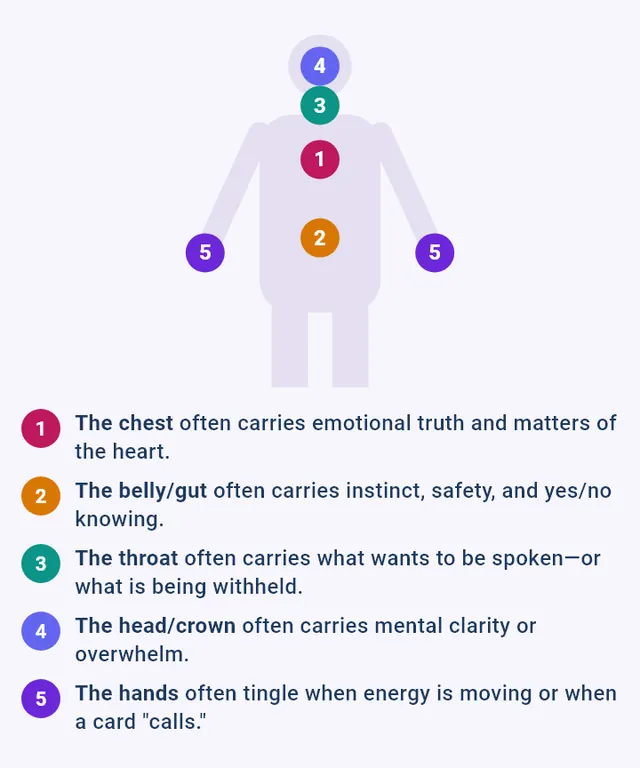
- The chest often carries emotional truth and matters of the heart.
- The belly/gut often carries instinct, safety, and yes/no knowing.
- The throat often carries what wants to be spoken—or what is being withheld.
- The head/crown often carries mental clarity or overwhelm.
- The hands often tingle when energy is moving or when a card "calls."
Write down the sensation, the card, and what unfolded. Over time your personal dictionary emerges.
Grounding: The Prerequisite
You cannot read the body if you are not in it. Anxiety, distraction, and rushing pull you into the head and mute somatic signals. Grounding returns you to the body so its whispers become audible.
A Simple Grounding Sequence
- Feel your feet or your seat making contact with the ground.
- Take three slow breaths, extending the exhale.
- Scan from crown to feet, noticing sensation without changing it.
- Silently say: I am here, and I am listening.
Ninety seconds of grounding transforms the quality of a reading.
Reading a Card Somatically
When a card appears, resist the impulse to interpret. Instead:
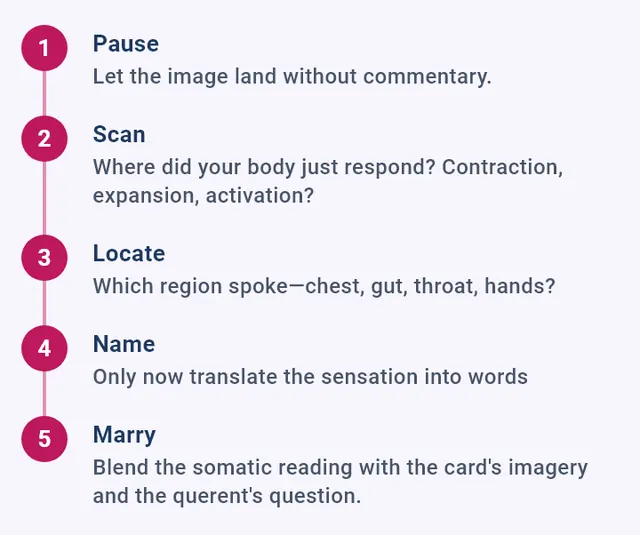
- Pause. Let the image land without commentary.
- Scan. Where did your body just respond? Contraction, expansion, activation?
- Locate. Which region spoke—chest, gut, throat, hands?
- Name. Only now translate the sensation into words: "There is a bracing in my chest, as if protecting something."
- Marry. Blend the somatic reading with the card's imagery and the querent's question.
The body gives you the emotional temperature; the card gives you the story; together they give you truth.
When Body and Mind Disagree
Sometimes your intellect says one thing and your body another. The card "should" be encouraging, yet your gut is uneasy. This tension is information, not error.
- Voice both. "On the surface this looks hopeful, and yet something in me hesitates here."
- Trust the body for emotional truth, the mind for structure and context.
- Let the querent's response reveal which layer was speaking. Often the body caught what the mind had rationalized away.
Reading the Querent's Body Too
Somatic awareness extends outward. As you speak, watch and feel:
- Where does the querent tense or soften?
- When do they hold their breath?
- Which words land in their body and which slide past?
Their body confirms or corrects your reading in real time, guiding you toward what truly matters.
Cautions and Care
- Distinguish signal from state. Hunger, fatigue, and caffeine create body noise. Ground first so you read the card, not your last coffee.
- Your body absorbs. You may feel the querent's grief or fear in your own chest. Learn to notice: Is this mine or theirs?
- Discharge afterward. Shake out your hands, stretch, breathe. Do not carry the residue of readings in your tissue.
Closing
The body is not separate from intuition—it is intuition's first home. As you learn its dialect, you gain a source of guidance that is immediate, honest, and always available. The cards will always be on the table. So will your body. Learn to read both.
Key Points
- The body registers a card's meaning faster than the thinking mind
- Three somatic channels: contraction, expansion, and activation
- No sensation is inherently good or bad—it is information
- Build a personal body map: chest, gut, throat, head, hands each speak
- Ground first, or hunger and fatigue drown out the signal
- When body and mind disagree, trust the body for emotional truth
Practices
- Body-map log: over ten readings, record where each card was felt and what unfolded
- Ninety-second grounding before every reading, then note the difference in clarity
- Draw one card, pause, and describe only the body sensation before any interpretation
- Practice the "mine or theirs?" check when you feel a strong emotion during a reading