
On this page
Introduction
Few topics divide readers like reversals—cards that appear upside-down. Some readers memorize a separate "reversed meaning" for all seventy-eight cards. Others ignore orientation entirely. The intuitive path offers a third way: treat a reversal not as a fixed opposite meaning to recall, but as a signal—a nudge from the deck saying "this card's energy is moving differently here; look closer."
This lesson frees you from memorized reversal charts and teaches you to read orientation the way you read everything else: through direct perception, imagery, and felt sense.
What a Reversal Actually Signals
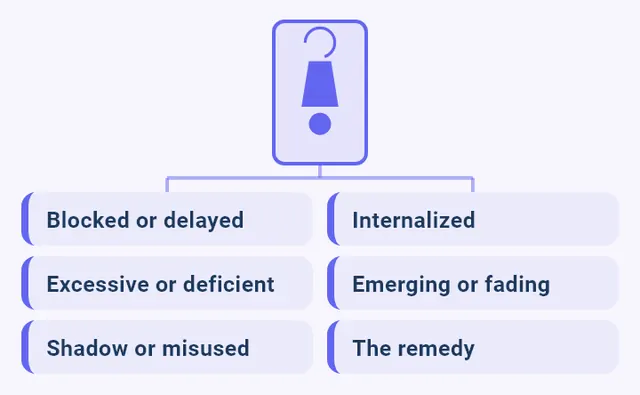
An upright card shows its energy flowing freely and outwardly. When a card lands reversed, that same energy is present but altered in flow. Rather than a single rule, a reversal can point to any of several shifts—and your intuition tells you which:
- Blocked or delayed: the energy is stuck, resisted, or not yet available.
- Internalized: the energy is turned inward—felt privately rather than expressed outwardly.
- Excessive or deficient: too much or too little of the card's quality.
- Emerging or fading: the energy is just arriving, or on its way out.
- Shadow or misused: the card's harder, less integrated expression.
- The remedy: sometimes a reversed difficult card softens; the challenge is releasing rather than arriving.
Notice these are not opposites but variations of movement. The card's core meaning remains; its direction and availability change.
Reading Reversals Intuitively
Instead of reaching for a memorized definition, engage the reversed card directly:
- Read the upright meaning first. What is this card's core energy?
- Feel the shift. With the card reversed, does the energy feel blocked, inward, excessive, fading, shadowed? Let your body and first impression answer.
- Look at the altered image. Literally—what now pours out, what is now on top, what figure now hangs upside-down? The reversed picture offers fresh visual cues.
- Ask the movement question. Is this energy coming or going? Stuck or releasing? Outward or inward?
- Marry it to context. The same reversal means different things in different positions and questions.
The reversal is a modifier, not a new card. You are reading the same energy in a different state of flow.
Using the Image When Reversed
Direct image-reading (an earlier lesson) works beautifully with reversals. When a card is upside-down:
- What was rising now falls, and what was falling now rises. The Ace of Cups upright pours blessing down; reversed, the cup empties or the flow reverses.
- Figures change relationship to the ground. A reversed figure may seem ungrounded, overturned, or seen from a new angle.
- What was hidden may become prominent. Details at the bottom rise to the top and demand attention.
Let the literal, physical inversion of the image speak before any rule does.
The Degree of Reversal
Reversals are not binary. Intuition can sense how reversed a card's energy is:
- A slightly reversed feel may mean mild delay or a hint of inward focus.
- A strongly reversed feel may mean deep blockage or full shadow expression.
- Sometimes a reversed card feels almost upright—the energy is nearly free, just emerging.
Trust these gradations. They give your readings nuance that a fixed chart cannot.
Should You Even Use Reversals?
There is no universal answer—only what serves your practice:
- Reading with reversals offers finer resolution: blocked vs. flowing, inner vs. outer. Many intuitive readers value this.
- Reading all cards upright keeps focus on core meanings and reads flow from card combinations and position instead. This is equally valid.
If you don't use reversals, you're not missing information—you simply read directional nuance through context rather than orientation. Choose consciously, and be consistent within a reading so your deck knows your language.
Common Pitfalls
- Defaulting to "negative." A reversal is not automatically bad. Blocked, inward, or emerging energies are often neutral or even helpful.
- Rigid opposite rules. "Reversed means the opposite" flattens the card. The Sun reversed is not "sadness"—it may be joy delayed, inner warmth, or temporary clouds.
- Over-reading orientation. Sometimes a card is simply reversed by shuffle chance and the intuitive charge is low. Feel whether the reversal matters here.
- Inconsistency. Deciding mid-reading whether reversals count muddies the signal. Set your intention before you begin.
Bringing It Together
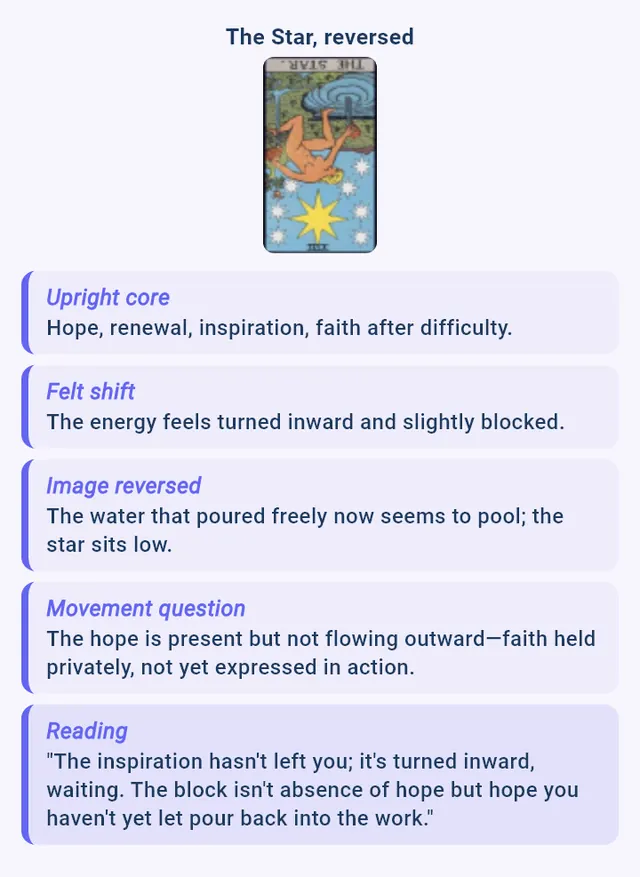
A worked example. You ask about a stalled creative project and draw The Star, reversed.
- Upright core: hope, renewal, inspiration, faith after difficulty.
- Felt shift: the energy feels turned inward and slightly blocked.
- Image reversed: the water that poured freely now seems to pool; the star sits low.
- Movement question: the hope is present but not flowing outward—faith held privately, not yet expressed in action.
- Reading: "The inspiration hasn't left you; it's turned inward, waiting. The block isn't absence of hope but hope you haven't yet let pour back into the work."
No chart delivered that. Direct, intuitive engagement did.
Closing
Reversals are not a second rulebook to memorize—they are an invitation to perceive more finely. Whether you use them or not, let orientation be one more thing you read rather than recall. The upside-down card is simply the deck asking you to look at familiar energy from an unfamiliar angle, and trust what you see.
Key Points
- A reversal is a signal about altered flow, not a fixed opposite meaning
- It can mean blocked, internalized, excessive, emerging, shadowed, or releasing
- Read reversals through felt sense and the literally inverted image, not a chart
- Reversals have degrees—sense how strongly reversed the energy feels
- Using reversals or not are both valid; just be consistent within a reading
- Never default a reversal to "negative"—many are neutral or helpful
Practices
- Draw ten reversed cards and, for each, name which shift it signals from felt sense alone
- Read a reversed card twice: once by chart, once purely by inverted image—compare the two
- For one week, decide before each reading whether reversals count, and stay consistent
- Take a "difficult" card reversed and practice reading it as a softening or release