
On this page
A row of cards is a sentence
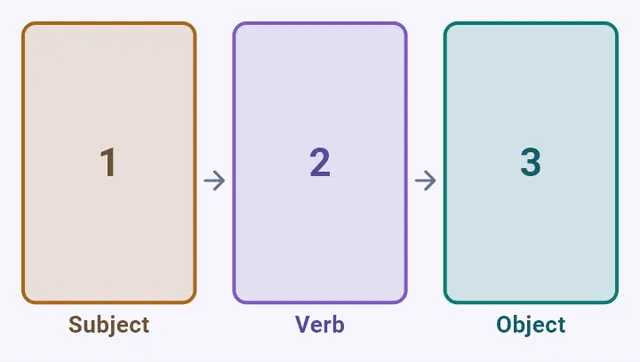
When cards fall in a line, resist reading each one as its own separate verdict. A linear spread behaves like a sentence: it has a subject, a verb and an object, and it flows from left to right. The card on the left is where the story begins; the middle card carries the action; the card on the right is where everything lands. Read this way, three cards stop being a list — leave, disaster, new love — and become a single moving thought.
The direction of the gaze
Rider–Waite–Smith images are full of people who are looking somewhere. In this deck the way a figure faces is a quiet piece of grammar: a character tends to "speak to" the card their eyes and body are turned toward, and to turn their back on what lies behind them. A knight riding to the right presses toward the future card; a figure gazing left is still tangled with what came before. Before you interpret, simply notice who is looking at whom. Cards whose figures face each other are in conversation; cards that face away form independent islands that may belong to different threads of the same question.
Causal bridges
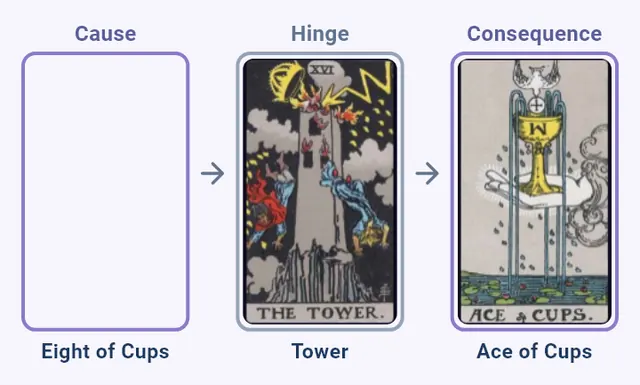
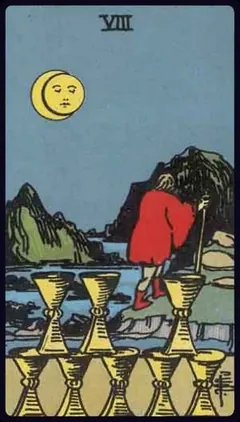
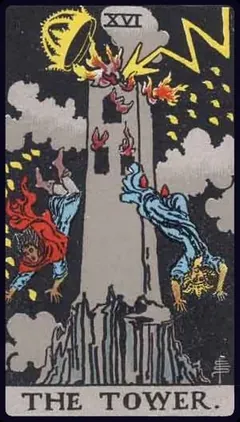
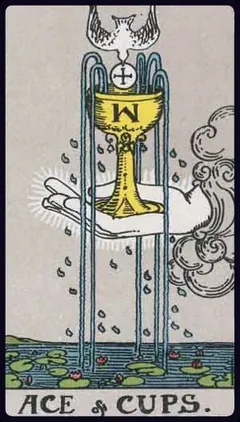
Between two neighbours there is almost always an implied verb — because, therefore, but, in spite of. Your job is to find the smallest honest bridge that connects them. Take the triad Eight of Cups → Tower → Ace of Cups. Read as isolated cards it says walking away, catastrophe, new feeling — three shocks with no thread. Read as a sentence it becomes one story: the voluntary departure of the Eight of Cups (I leave what no longer nourishes me) precipitates the sudden break of the Tower (the old structure falls), which clears the ground for the clean, welling emotion of the Ace of Cups (a feeling begins again from zero). The abandonment is the cause; the Tower is the hinge; the Ace is the consequence.
Hard and soft in the middle
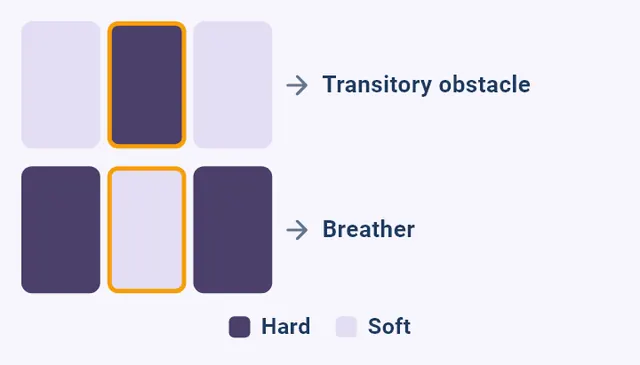
The position of a difficult card changes what it means. A hard card set between two gentle ones usually reads as a transitory obstacle — a wall you pass through, not a wall you live behind, because the cards on either side promise softer ground. Conversely, a gentle card set between two hard ones is a breather: a pocket of relief inside a harder stretch. The Tower in our triad is not the end of the world; it sits between two Cups, so it is the violent doorway between one emotional chapter and the next.
In practice
Reading adjacency is a discipline of slowness. Lay the row, read left to right, name the verb between each pair, follow the gazes, and only then decide what the line as a whole is saying. This is the same muscle you will use in the Complete readings course, where full spreads are worked case by case. A spread is not a stack of meanings; it is a sentence waiting to be read aloud.
COMBINATION EXAMPLES
Key points
- A linear spread reads left to right like a sentence: subject → verb → object.
- In Rider–Waite–Smith, the way a figure faces points to the card it is speaking to.
- Find the smallest honest verb — because, therefore, but — that bridges each pair.
- A hard card between two gentle ones is a passing obstacle; a gentle card between two hard ones is a breather.
- 8 of Cups → Tower → Ace of Cups is one story of cause, hinge and consequence, not three separate verdicts.
Exercises
- Lay any three cards in a row and write one sentence that links them subject–verb–object.
- For every figure card in a spread, note which way it faces and which neighbour it addresses.
- Find a hard-between-soft or soft-between-hard pattern in a past reading and re-read the middle card as obstacle or respite.
SOURCES & READING
- Mary K. Greer, 21 Ways to Read a Tarot Card (2006)
- A.E. Waite, The Pictorial Key to the Tarot (1910)
- Rachel Pollack, Seventy-Eight Degrees of Wisdom (1980)
- Rachel Pollack, Tarot Wisdom (2008)
- Benebell Wen, Holistic Tarot (2015)