
On this page
Sooner or later, every serious student hits a confusing wall. You calculate your chart in this app, then try another app or a Vedic astrologer, and suddenly your Sun sign has "changed." Or you read that your rising sign falls in one house system but not another. Nothing is broken. You have simply crossed between different frameworks, each internally consistent and built for a different purpose.
This lesson untangles two independent choices every chart quietly makes: which zodiac (tropical or sidereal) and which house system (Placidus, Whole Sign, Equal). Knowing the difference lets you compare traditions without confusion.
Two zodiacs, one sky
The zodiac is a 360° band divided into twelve 30° signs. The disagreement is not about the number of signs but about where 0° Aries is anchored.
- The tropical zodiac anchors the signs to the seasons. By definition, 0° Aries is the spring equinox in the Northern Hemisphere — the moment the Sun crosses the celestial equator going north. The signs are tied to the turning points of the solar year, not to any group of stars.
- The sidereal zodiac anchors the signs to the fixed stars and constellations. Here 0° Aries is meant to sit against an actual stellar backdrop.
This app, like most Western astrology, uses the tropical zodiac. Vedic astrology (jyotish), and some Western siderealists, use the sidereal zodiac.
Precession: why the two drift apart
If the seasons and the stars had stayed locked together, the two zodiacs would agree and no one would argue. But the Earth's axis slowly wobbles like a spinning top, a motion called the precession of the equinoxes. It takes roughly 25,800 years to complete one cycle.
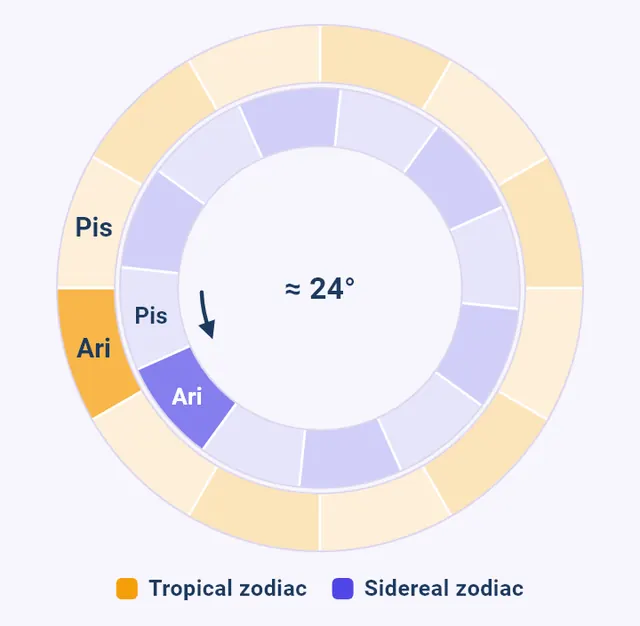
Because of precession, the spring equinox point slowly slides backward against the constellations — about 1° every 72 years. Two thousand years ago, when much of Western astrology was formalized, the tropical and sidereal frames nearly coincided. Since then they have drifted apart.
Today the gap is roughly 24°. Astrologers call this offset the ayanamsa (there are several slightly different values). Practically, 24° is almost a whole sign. That is why, if you were born in the last days of a tropical sign, your sidereal Sun sign can land in the previous sign. A late-March tropical Aries may read as sidereal Pisces. Your Sun did not move — you are measuring it against a different origin point.
Neither one is "correct"
It is tempting to ask which zodiac is true. That question misreads what each system is doing.
- The tropical zodiac is a map of the Sun–Earth seasonal relationship. Aries "is" the surge of spring, Cancer the peak of summer light, Capricorn the depth of winter. It describes cycles of light, growth, and season on Earth.
- The sidereal zodiac is a map of the planets against the star field. It keeps the signs aligned with the visible constellations over long stretches of time.
These are two different reference frames, like measuring temperature in Celsius versus Fahrenheit, or giving a location by street address versus GPS coordinates. Each is valid within its own logic; neither makes the other a lie. A Vedic chart is not a broken Western chart, and vice versa. When you compare apps, first check which zodiac each one uses — most surprises dissolve immediately.
House systems (a separate question)
The zodiac tells you where a planet is by sign. The houses tell you which area of life it colors — self, money, communication, home, and so on. Crucially, choosing a zodiac and choosing a house system are independent decisions. The house debate below lives entirely inside the tropical/Western tradition, though the systems can be applied in either zodiac.
All house systems agree that there are twelve houses and that the Ascendant (the rising degree on the eastern horizon) is a key reference. They disagree about where the cusps — the boundaries between houses — fall.
- Placidus is the most common system in modern software, so it is what many people see by default. It is a time-based system: it divides the time it takes a degree to rise from the horizon to the midheaven and splits that into houses. It produces houses of unequal size and can behave strangely at very high latitudes.
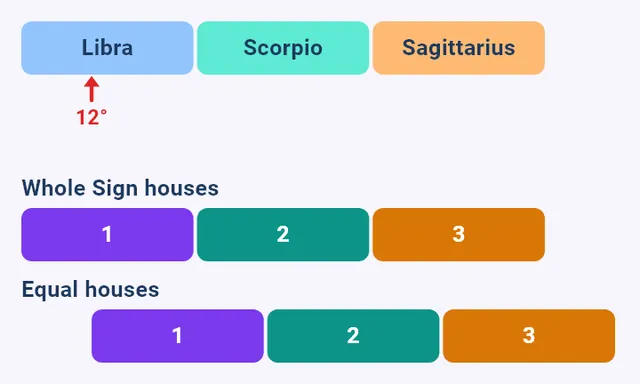
- Whole Sign houses is an ancient system, central to Hellenistic and Vedic practice. The rule is simple: each sign is one whole house. If your Ascendant is anywhere in Libra, the entire sign of Libra is the 1st house, Scorpio is the 2nd, and so on. Cusps and signs line up perfectly.
- Equal houses takes the exact degree of the Ascendant and marks off 30° segments from there. So if you rise at 12° Libra, the 2nd house begins at 12° Scorpio, the 3rd at 12° Sagittarius, and so on — twelve equal slices, but offset from the sign boundaries.
This app uses Whole Sign houses. Your 1st house is the whole sign of your Ascendant, from 0° to 30°, and each following sign is the next house. That is why a planet a few degrees above the Ascendant, in the same sign, is in the 1st house here, while a Placidus chart may put it in the 12th.
When two charts seem to disagree about which house a planet is in, the culprit is almost always a different house system, not an error. There is no universally "right" one; astrologers choose by tradition and by what reads well for them.
A note for the Southern Hemisphere
Here is a subtlety many apps never mention. The tropical zodiac's seasonal symbolism is built from the Northern Hemisphere. "Aries = spring, the year waking up," "Cancer = midsummer," "the waxing half of the year = growing" — all of that assumes a boreal calendar.
If you were born in Brazil, Argentina, Australia, South Africa or anywhere south of the equator, the physical seasons are reversed. When it is tropical Aries season (late March), the Southern Hemisphere is heading into autumn, not spring.
What do Southern astrologers do in practice? The large majority keep the standard tropical zodiac — your Sun sign does not change by hemisphere. What needs adapting is the seasonal poetry layered on top of it. If a lesson says "Aries is the sprouting seed, the first warmth," a reader in Buenos Aires can translate that to the archetypal meaning (initiation, raw beginning, forward drive) rather than the literal weather outside the window. A minority of Southern astrologers deliberately flip the seasonal imagery; most simply hold the archetype and set aside the local weather. Either way, keep the signs, adapt the season metaphor.
What this means for your tarot practice
This matters directly for the card–sign correspondences you meet throughout this app. The links between tarot cards and zodiac signs used here follow the Golden Dawn system — for example, the Emperor with Aries, the Wheel of Fortune with Jupiter, the elemental dignities of the suits. These attributions are tropical. They were built inside the Western, season-based framework.
So if you take your sidereal (for instance Vedic) chart and try to line it up with this app's tarot correspondences, things can look shifted by roughly a sign. Your Golden Dawn "Sun card" may not match the sign a Vedic app gives you. This is not a bug in the app and not a contradiction in tarot — it is exactly the ~24° tropical–sidereal offset showing up in the cards.
The practical rule: use one framework consistently. For the tarot correspondences in this app, stay with your tropical placements, because that is the system the card attributions were designed for. If you want to explore your sidereal chart, do it as a separate study, and translate rather than mix. Knowing which map you are standing on is the whole skill — the sky has not changed, only the grid we lay over it.
Key Points
- The tropical zodiac anchors the signs to the seasons: 0° Aries = the Northern-Hemisphere spring equinox. This app, like most Western astrology, uses it.
- The sidereal zodiac anchors the signs to the fixed stars/constellations, as in Vedic astrology (jyotish).
- Because of the precession of the equinoxes, the two frames have drifted about 24° apart (the ayanamsa) — nearly a whole sign — so your sidereal Sun sign can differ.
- Neither zodiac is 'right' or 'wrong': they are different reference frames for different purposes.
- House systems are a separate choice: Placidus (most common in software, time-based), Whole Sign (ancient, each sign = one house), Equal (30° from the Ascendant). They differ in where the cusps fall.
- The app's card–sign links follow the Golden Dawn system and are TROPICAL; a sidereal chart will look shifted by ~a sign — that is not an app error.
Tarot Correspondences
- The Emperor–Aries link (and all Golden Dawn card–sign attributions in this app) is measured in the TROPICAL zodiac, i.e. from the spring equinox — not against the visible constellations.
- If your Sun is late in a tropical sign, a sidereal (Vedic) reading may place it in the previous sign, so your 'Sun card' can seem to change — the ~24° ayanamsa at work, not a tarot contradiction.
- The elemental dignities of the suits (Wands=Fire, Cups=Water, Swords=Air, Pentacles=Earth) rest on the tropical seasonal wheel; keep tropical placements when pairing cards with signs.
- House systems do not change a card's sign rulership, only which life-area a placement lands in; a Placidus vs Whole Sign chart can move a planet's 'house card' theme without touching the card–sign correspondence.
- Southern-Hemisphere readers keep the same tarot–sign correspondences, but should read season-based card symbolism (e.g. 'The Empress as spring fertility') as archetype, not literal local weather.
- For consistent readings, pick one framework: use your tropical chart with this app's card correspondences, and study a sidereal chart separately rather than mixing the two.
Further Reading
- Robert Hand — Horoscope Symbols (on the tropical framework and the meaning of house divisions)
- Deborah Houlding — The Houses: Temples of the Sky (history and logic of the house systems)
- James Braha — Ancient Hindu Astrology for the Modern Western Astrologer (the sidereal zodiac and ayanamsa explained for Western readers)